Tankless Review
A.O. Smith ATI-540P-N 199,000 BTU Tankless Review
Researched from the DOE test procedures, NFPA 54 and NEC code tables, and manufacturer specifications. Updated .
Quick answer
The ATI-540P-N's Amazon title states "10 GPM, 199K BTU," which is the largest input in this review series by a meaningful margin. Bigger input generally means more flow held up at a given temperature rise, which is exactly what a large house with many simultaneous draws needs.
What the title does not state is the temperature rise the 10 GPM figure applies to, and the practical limit on a unit this size is rarely the unit itself. It is almost always the gas line feeding it. This review covers both.
What the specifications actually say
The listing publishes a 199,000 BTU input, condensing operation, natural gas fuel, indoor mounting, and a title-stated maximum flow of 10 GPM with no rise attached. It does not publish a UEF, dimensions, weight or minimum activation flow in the fields we draw from. Using the published 199,000 BTU input and an assumed 93 percent condensing efficiency, here is what that input produces across a range of rises.
| Temperature rise | Assumed flow (GPM) | A scenario that rise represents |
|---|---|---|
| 30 F | 12.3 | A warm-climate summer inlet feeding several fixtures at once |
| 50 F | 7.4 | A moderate climate, a common winter target rise for a large house |
| 70 F | 5.3 | A cold groundwater winter inlet, still supporting multiple bathrooms |
| 90 F | 4.1 | A very cold inlet raised to a 120 F setpoint |
Published standard Source: 199,000 BTU input from the Amazon listing. GPM computed from Q = BTU x efficiency / (rise x 8.33 x 60), with a 93 percent condensing efficiency assumed, not measured or A.O. Smith published.. A.O. Smith publishes its own flow-versus-rise curve in the installation manual. Compare the assumption above against that document before sizing a purchase around it.
Who this unit suits
The ATI-540P-N is built for a large house, several bathrooms running at once, or a property that has already outgrown a smaller tankless unit's flow at a normal winter rise. Even at a demanding 70 F rise, the assumed math above holds up over 5 GPM, enough to keep multiple fixtures running without the cold water penalty a smaller unit would hit first.
It also suits a new construction or major renovation where the gas line is being run or resized as part of the same project, since the gas service is the actual constraint on a unit this size, not the appliance. Confirm total household demand with the peak hour demand calculator before committing to the largest available input.
Who should not buy it
Anyone whose existing gas meter and line were sized for a smaller appliance, whether a 40 gallon tank or a smaller tankless unit, should not assume the existing line supports 199,000 BTU without checking it against a capacity table first. This is the single most common reason a unit this size ends up returned or reinstalled with a resized line, an expensive mistake to discover after delivery.
A typical two to three bathroom house does not need this much input, and the Rheem RTGH-84 at 157,000 BTU covers that case at a lower gas demand and a smaller connection requirement. Buying the largest number on the page "to be safe" is not the efficient choice for a smaller household.
What the installation actually involves
The single largest constraint on installing this unit is the gas line. A 199,000 BTU appliance demands a meaningfully larger pipe diameter than a 120,000 to 160,000 BTU unit over the same run length, sized against NFPA 54 / IFGC capacity tables using the gas line size calculator, not assumed from whatever pipe already feeds an existing water heater. In many cases the gas utility also needs to confirm the meter itself can support the added load alongside a furnace or range on the same service.
As a condensing unit it vents in PVC and needs a condensate neutralizer, the same as any other condensing indoor unit in this review series. Gas line work, venting and the gas utility coordination belong to a licensed plumber or gas fitter. Installation labor cost estimating is covered at houseprojectcalc.com, not here.
How we researched this
We did not install this unit or run water through it at any of the rises in the table above. This review is compiled from A.O. Smith's published Amazon listing, including the title's stated 10 GPM figure, and the consensus of verified owner reviews on that listing, cross-checked against the standard heat transfer relation that governs any gas tankless heater. The gas line limitation described here is a general fact about large-input gas appliances, not a claim from hands-on installation of this specific unit.
Alternatives and what a 199,000 BTU unit needs
A unit this size is a step up from most residential retrofits. The picks below cover a smaller step-up alternative and the accessories a large condensing unit specifically needs.

Rheem RTGH 9.0 GPM Natural Gas Indoor
$1,219.99A 180,000 BTU condensing indoor unit, for a large house that does not quite need the full 199,000 BTU input and the larger gas line it demands.
Best for: Cold groundwater regions where the rise eats the flow
Check price on Amazon
Rinnai RX160iN Condensing
$1,442.70A condensing indoor competitor with sensing electronics aimed at the cold water sandwich, worth considering if draw cycling matters as much as peak capacity.
Best for: Three bathroom houses in a cold inlet region
Check price on Amazon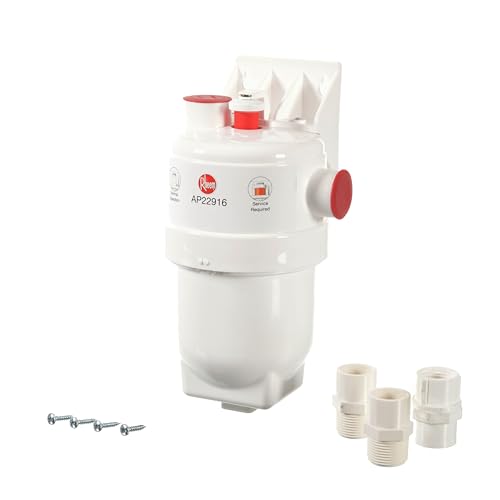
Rheem Axiom External Neutralizer RTG20329AR
$149.85Condensate from a condensing unit this size still runs acidic and still needs neutralizing before it reaches a drain.
Best for: A Rheem condensing tankless that must pass inspection
Check price on Amazon
TTFLEX 36 in Gas Flex Line, 3/4 in
$28.99A longer flexible gas connector sized for the final run to a large unit, appropriate for a mechanical room where the connection point sits farther from the shutoff.
Best for: A gas heater set away from the shutoff
Check price on AmazonFrequently asked questions
- Does the A.O. Smith ATI-540P-N actually deliver 10 GPM?
- The listing title states 10 GPM as a maximum flow figure without naming the temperature rise it was measured at. At a 70 F rise, the published 199,000 BTU input works out to roughly 5.3 GPM under an assumed 93 percent efficiency, a more realistic winter planning figure for a large household.
- What size gas line does a 199,000 BTU tankless heater need?
- The correct pipe size depends on the total run length and fitting count between the meter and the unit, sized against NFPA 54 / IFGC capacity tables. A 199,000 BTU appliance typically needs a larger diameter than a 120,000 to 160,000 BTU unit over the same run, so an existing line should never be assumed adequate.
- Is the A.O. Smith ATI-540P-N overkill for a typical house?
- For a two to three bathroom house, yes. A 157,000 BTU condensing unit like the Rheem RTGH-84 covers that case with a smaller gas connection requirement. The ATI-540P-N is built for large houses running multiple bathrooms simultaneously, where the larger input actually gets used.
- Does the ATI-540P-N need a condensate neutralizer?
- Yes. It is a condensing unit, and its condensate runs mildly acidic like any other condensing tankless heater, which most local plumbing codes require neutralizing before it reaches a drain. On a unit producing this much output, plan for a neutralizer sized to match the higher condensate volume rather than a small cartridge built for a much smaller residential unit, and check its media level on the same schedule as the annual descale.
- Can my existing gas meter support a 199,000 BTU tankless heater?
- Not necessarily. The gas utility needs to confirm the meter can support the added load alongside any other gas appliances already on the same service, such as a furnace or range, before a line this large is installed. This is a step to take before ordering, not after.
- What is the difference between the ATI-540P-N and a 180,000 BTU unit?
- The extra roughly 19,000 BTU mainly shows up at a cold rise, where the assumed flow difference between a 199,000 and a 180,000 BTU condensing unit is close to half a gallon per minute. For most houses that difference is not decisive; for a large house with many simultaneous draws in a cold climate, it can be.
Safety note: never install a large-input gas appliance on an existing line without checking it against a capacity table first, and confirm with the gas utility that the meter itself supports the added load.