Tankless
Best Gas Tankless Water Heaters
Researched from the DOE test procedures, NFPA 54 and NEC code tables, and manufacturer specifications. Updated .
Quick answer
Gas tankless units heat water at a far higher instantaneous rate than a standard tank water heater, and that rate is exactly what makes them capable of true whole-house service. It is also what makes the gas line feeding them the part of the project buyers most often underestimate.
A standard 40 gallon gas tank water heater typically fires at around 40,000 BTU/h. A whole-house tankless unit can call for 150,000 to 200,000 BTU/h or more. The existing branch line run to a tank water heater was very likely sized for the tank, not for a tankless unit's full input, and running it undersized starves every appliance sharing that gas main, not just the water heater. This is the hidden cost this page keeps front and center: budget for the gas line conversation before you fall for a headline flow number.
Check your line against the gas line size calculator before ordering, and use natural gas and propane pipe sizing (they differ) per NFPA 54 / International Fuel Gas Code capacity tables, which is a standard, not a rule of thumb.
Why does a tankless unit need a bigger gas line than a tank?
A gas line is sized to carry a maximum total BTU/h load at an acceptable pressure drop over its length, per NFPA 54 / International Fuel Gas Code capacity tables. That is a standard, published, code-referenced calculation, not a rule of thumb. A branch line sized years ago for a 40,000 BTU/h tank water heater is very often undersized for a tankless unit calling for 150,000 to 199,000 BTU/h, especially if the run is long or shares a main with a furnace and a range.
The fix is either an upsized branch line or, on a longer run, upsizing further back toward the meter. This is real cost that a tankless unit's sticker price does not include, and it is why "tankless costs more than a tank up front" understates the comparison if the gas line also needs work.
What temperature rise does the advertised GPM assume?
None stated, and that is the point. Amazon listing titles quote a maximum flow figure like "8.4 GPM" with no attached temperature rise, because the true output varies continuously with how cold the incoming water is. A unit rated near 10 GPM on a listing might deliver closer to 5 GPM once it is heating 37 F winter groundwater up to a 120 F setpoint, an 83 F rise, roughly double the rise (and roughly half the flow) of a mild climate's 40 F rise. Manufacturers publish the full flow-versus-rise curve in the spec sheet or owner's manual; that curve is the number to trust, not the headline GPM on the listing.
| Approximate rise | Flow relative to the rated maximum | Typical incoming water condition |
|---|---|---|
| 35 to 40 F | Near the rated maximum GPM | Warm climate, groundwater near 65 to 70 F |
| 55 to 65 F | Roughly two thirds of rated GPM | Moderate climate, groundwater near 50 to 55 F |
| 75 to 85 F | Roughly half of rated GPM | Cold climate winter, groundwater near 35 to 45 F |
Published standard Source: Manufacturer published flow-versus-temperature-rise curves; the general inverse relation between flow and rise follows from Q = m x c x dT.. This table shows the shape of the relationship, not a specific model's numbers. Always check the manufacturer's own curve for the exact unit you are buying.
How we chose these picks
These picks were compiled from manufacturer published specifications, installation manuals and the consensus of verified owner reviews. We did not install, test or run any of these units ourselves. Where a listing does not state a figure, such as flow at a specific temperature rise, we say so rather than guessing.
Buying tips for a gas tankless purchase
- Confirm gas line capacity before ordering, not after. Use the gas line size calculator against your run length and existing appliances.
- Decide condensing versus non-condensing before you shop, since that decision drives whether you can vent in PVC or need stainless.
- Every gas tankless unit needs isolation service valves for descaling; confirm they are on your order, not assumed to be bundled.
- Installation labor and gas line modification cost is not something we price here; that is houseprojectcalc.com's territory.
Gas line sizing math is yours to check; running or modifying the line is a licensed gas fitter's job. An undersized or improperly connected gas line is a safety hazard, not just a performance problem.
The picks, by tier
These picks are natural gas models unless noted; propane-specific buying is covered on its own page since the model numbers genuinely differ by fuel and are not interchangeable.

Rheem RTG 7.0 GPM Natural Gas Indoor
$653.77A compact indoor natural gas unit for a single bathroom, condo or small house at the entry end of whole-house gas tankless.
Best for: A one or two bathroom house in a warm inlet climate
Check price on Amazon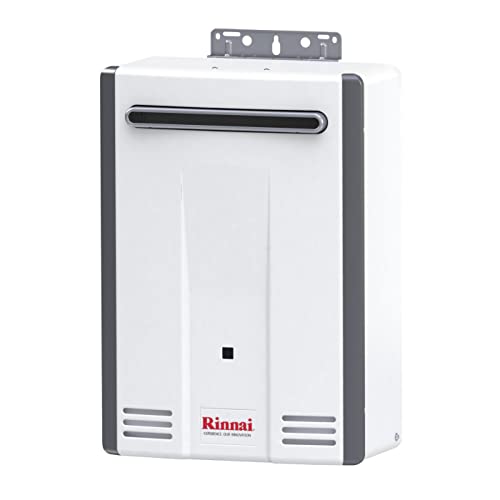
Rinnai V53DeN Natural Gas
$589.00A non-condensing indoor unit that vents through standard stainless steel rather than PVC, a simpler retrofit into an existing flue chase.
Best for: A single bathroom house or a dedicated fixture group
Check price on Amazon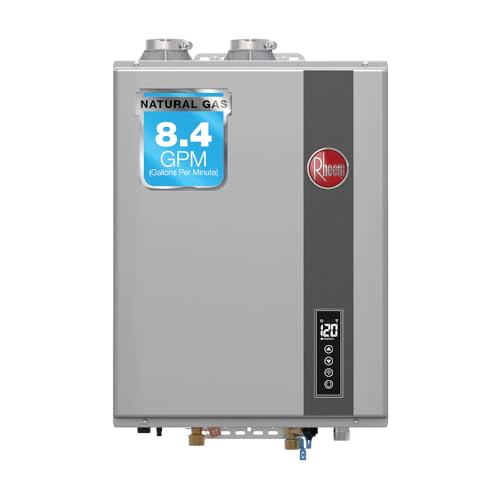
Rheem RTGH 8.4 GPM Natural Gas Indoor
$1,168.99The buy-once whole-house pick, with enough published flow for two to three fixtures without stepping up to the largest condensing models.
Best for: The common two to three bathroom whole house replacement
Check price on Amazon
Rheem RTGH 6.8 GPM Natural Gas Indoor
$1,001.00A smaller condensing option for a two to three bedroom house that does not need the largest unit's capacity or its cost.
Best for: A smaller house that still wants PVC venting
Check price on Amazon
Rinnai RX130iN Condensing
$1,264.20Recirculation-ready out of the box, useful for a house that also wants faster hot water delivery to distant fixtures.
Best for: Households that run short, repeated draws
Check price on Amazon
Rheem RTGH 9.0 GPM Natural Gas Indoor
$1,219.99The top of the gas lineup here, for a large house or high simultaneous demand, at a real step up in gas line and installed cost.
Best for: Cold groundwater regions where the rise eats the flow
Check price on Amazon
Rinnai RX160iN Condensing
$1,442.70The highest published flow in this lineup, aimed at big houses or short-term rentals running several bathrooms at once.
Best for: Three bathroom houses in a cold inlet region
Check price on Amazon
A.O. Smith ATI-540P-N 199K BTU
$1,449.99A high-capacity condensing unit that is a genuine alternative to the largest Rheem and Rinnai models at the same tier.
Best for: Large houses, and only after the gas line has been sized
Check price on AmazonFrequently asked questions
- Do I need to upsize my gas line for a tankless water heater?
- Very often, yes. A tankless unit can call for 150,000 to 199,000 BTU/h versus roughly 40,000 BTU/h for a standard tank water heater, and the existing branch line was likely sized for the tank. Check the required pipe diameter against NFPA 54 / International Fuel Gas Code capacity tables for your run length before ordering a unit.
- What GPM tankless water heater do I need for a whole house?
- Size to your worst simultaneous draw at your coldest winter groundwater temperature, not the headline GPM on the box. A household needing 6 to 8 gallons per minute at a large winter rise typically needs a larger unit such as the Rheem RTGH-90 or Rinnai RX160iN rather than an entry-level model rated near 7 GPM at a mild rise.
- Why does my tankless unit deliver less flow in winter than the box advertises?
- Because the advertised GPM figure assumes a specific temperature rise that the listing usually does not state, and winter groundwater is colder, which means a larger rise to reach your setpoint. The same unit can deliver roughly half its rated flow at double the rise. The manufacturer's flow-versus-rise curve, not the box number, tells you the real winter capacity.
- Is a condensing or non-condensing gas tankless unit better?
- Condensing units extract more heat from the exhaust, run higher efficiency, and can vent in PVC, but they add a condensate drain that must go somewhere. Non-condensing units vent in stainless steel, cost less up front, and skip the condensate plumbing. The choice usually comes down to whether a PVC vent run or a condensate drain path is easier in your specific install.
- How often does a gas tankless water heater need to be descaled?
- A common convention is annually in most water conditions, and more often in hard water areas. Scale buildup on the heat exchanger reduces efficiency and can trigger error codes over time. Isolation service valves, installed at the time of the water heater, make this a manageable DIY flush rather than a service call each time.
- Can I install a gas tankless water heater myself?
- The unit mounting and wiring for controls are often within a confident DIYer's reach, but the gas line connection and venting are not. Improper gas connections and flue venting are where carbon monoxide risk and fire risk both live, and this work should go to a licensed plumber or gas fitter regardless of how straightforward the manual makes it look.
Size the gas line before you size the heater. A tankless unit that cannot get enough gas will underperform its rating regardless of how good the unit itself is, and an undersized line is a safety problem, not just a performance one.