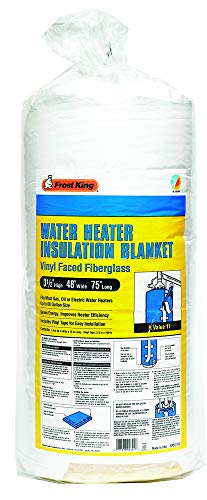
Frost King SP57 R10 Blanket, 48 x 75 in
$32.54R10 stated on the package, which is the only number worth comparing between blankets. Many listings publish none.
Best for: An older tank that is warm to the touch
Check price on AmazonEfficiency calculator
Quick answer
A solar collector pre-heats water before the main heater, so the saving is the fraction of the load it covers. Forty square feet of collector at 1,500 BTU per square foot per day and 45 percent efficiency collects about 27,000 BTU, which covers most of a 55 gallon daily load at a 70 F rise.
Result
This is an average day figure. A solar system still needs the conventional heater behind it for cloudy weeks and winter nights, which is why the honest framing is pre-heat rather than replacement. Freeze protection is the other requirement people underestimate in cold climates.
The formula
Collected BTU per day = collector area x site insolation x collector efficiency. Fraction covered = collected / (gallons x 8.33 x rise).
This calculator will not guess your insolation. A collector output depends on the solar resource at your site, the collector published efficiency curve and the inlet temperature, and none of those can be inferred from a postcode. Take the insolation figure from the NREL solar resource maps for your location and the efficiency from the collector specification sheet.
The figures above are computed with these exact inputs: Collector area 40 sq ft, Site insolation 1500 BTU/sq ft/day, Collector efficiency 45 %, Hot water per day 55 gal, Temperature rise 70 F.
Some of these are published test procedures or code tables and some are planning conventions. They are not the same kind of number, so each one is labeled.
| Assumption | Kind | Where it comes from |
|---|---|---|
| Solar Efficiency: 0.45 | Convention | Assumed average collector efficiency. Use the collector manufacturer published efficiency curve where you have it |
| Water Weight: 8.33 | Published standard | Published density of water at 60 F, 8.33 lb per gallon |
Every card below is in the page source. The calculator re-ranks them against your numbers and marks anything that falls short of what you just calculated.
R10 stated on the package, which is the only number worth comparing between blankets. Many listings publish none.
Best for: An older tank that is warm to the touch
Check price on Amazon
The larger size for a 75 or 80 gallon tank, where a 48 by 75 blanket leaves a strip uncovered.
Best for: A 75 or 80 gallon tank
Check price on Amazon
Polyethylene rather than fibreglass, so it can be fitted without the itch and can be cut around the controls cleanly.
Best for: Anyone who does not want fibreglass in a closet
Check price on Amazon
R12 rather than R10, which is the highest stated value in this catalog. Leave the top of a gas tank and the draft hood clear regardless.
Best for: The coldest garages and basements
Check price on Amazon
The first six feet of hot outlet pipe is where most of the standing heat loss happens, and this is the cheapest fix on the entire site.
Best for: The first six feet off the tank
Check price on Amazon
Three quarter inch inside diameter, which is the size that fits 3/4 inch nominal copper. Measure the pipe, not the fitting.
Best for: A 3/4 in copper hot line
Check price on AmazonResearched guidance, not professional advice. These results are planning figures from published test procedures, code tables and manufacturer specifications, and they do not replace a sizing done by the person who will sign the permit. A water heater is a pressure vessel: never cap, plug or remove the temperature and pressure relief valve, and replace one that will not open when the test lever is lifted. Gas line, flue and vent work belongs to a licensed plumber or gas fitter, because improper venting produces carbon monoxide. Water at 140 F scalds a child in seconds. Turn off the breaker before touching an element, and never energise an element that is not submerged.