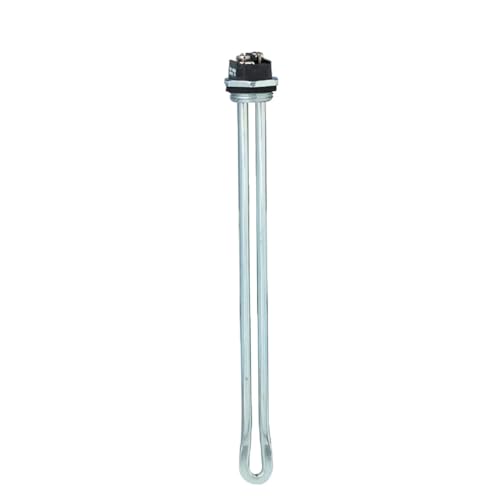
Camco 4500W 240V Foldback Element
$12.85Low watt density, which spreads the same 4,500 watts over more surface area so it scales more slowly in hard water.
Best for: Hard water, where elements scale and burn out
Check price on AmazonSizing calculator
Quick answer
Recovery rate is gallons per hour a heater reheats. A 36,000 BTU gas burner at 80 percent efficiency recovers about 38 gallons per hour through a 90 F rise, while a 4,500 watt electric element recovers about 20 gallons per hour through the same rise.
Result
Recovery rate is what stops you running out on the third shower. It is also why a gas tank of the same gallons outperforms an electric one, and why a heat pump water heater in compressor-only mode feels slow despite costing far less to run.
The formula
Gas GPH = BTU/h x efficiency / (8.33 x rise). Electric GPH = kW x 3412 / (8.33 x rise).
This is the same energy balance as every other calculation on this site, rearranged. Efficiency here is thermal efficiency at the burner, which is not the same thing as the UEF on the label: UEF is measured over a whole day and includes standby loss, so it is always the lower number.
The figures above are computed with these exact inputs: Heat source gas, Burner input 36000 BTU/h, Thermal efficiency 80 %, Element rating 4.5 kW, Temperature rise 90 F, Tank size 50 gal.
Some of these are published test procedures or code tables and some are planning conventions. They are not the same kind of number, so each one is labeled.
| Assumption | Kind | Where it comes from |
|---|---|---|
| Water Weight: 8.33 | Published standard | Published density of water at 60 F, 8.33 lb per gallon |
| Gas Efficiency: 0.8 | Convention | Assumed thermal efficiency for an atmospheric gas burner. Use the efficiency on your own unit data plate where it is published |
| Btu Per Kwh: 3412.14 | Published standard | Exact conversion between the international table BTU and the kilowatt hour |
Every card below is in the page source. The calculator re-ranks them against your numbers and marks anything that falls short of what you just calculated.
Low watt density, which spreads the same 4,500 watts over more surface area so it scales more slowly in hard water.
Best for: Hard water, where elements scale and burn out
Check price on Amazon
The plain screw-in 4,500 watt element, which is what most electric tanks use in both positions.
Best for: A straightforward element replacement
Check price on Amazon
The manufacturer part for a Rheem tank, which removes any question about gasket size and thread type.
Best for: A Rheem electric tank
Check price on Amazon
The lower thermostat, which is the one that fails when a tank makes a little hot water and then runs cold quickly.
Best for: A tank that runs out too fast
Check price on Amazon
Upper and lower thermostats together, which is the sensible way to buy them because the two are wired in series and the fault is often not obvious.
Best for: Diagnosing a no-hot-water electric tank
Check price on Amazon
Dielectric nipples separate copper from the steel tank so the joint does not corrode galvanically, and the heat trap stops convection up the pipe.
Best for: Every tank replacement with copper pipe
Check price on AmazonResearched guidance, not professional advice. These results are planning figures from published test procedures, code tables and manufacturer specifications, and they do not replace a sizing done by the person who will sign the permit. A water heater is a pressure vessel: never cap, plug or remove the temperature and pressure relief valve, and replace one that will not open when the test lever is lifted. Gas line, flue and vent work belongs to a licensed plumber or gas fitter, because improper venting produces carbon monoxide. Water at 140 F scalds a child in seconds. Turn off the breaker before touching an element, and never energise an element that is not submerged.