BTU & Energy
Water Heater BTU Chart
Researched from the DOE test procedures, NFPA 54 and NEC code tables, and manufacturer specifications. Updated .
Quick answer
BTU, or British thermal unit, is the amount of heat needed to raise one pound of water by one degree Fahrenheit. Water weighs 8.33 pounds per gallon at typical residential temperatures, so the BTU needed to heat any volume of water through any temperature rise follows directly from multiplying those two numbers by the rise. Every gas input rating, every electric wattage rating, and every fuel conversion on this site traces back to that single relation.
This chart works the BTU arithmetic from first principles, then converts the result into the units you actually see on a nameplate: cubic feet of natural gas per hour, and kilowatts. The gas line size calculator and breaker size calculator carry this math forward into pipe and wire sizing.
How many BTU does it take to heat one gallon of water?
| Temperature rise | BTU per gallon |
|---|---|
| 35 F | 292 BTU |
| 45 F | 375 BTU |
| 55 F | 458 BTU |
| 60 F | 500 BTU |
| 65 F | 541 BTU |
| 75 F | 625 BTU |
| 85 F | 708 BTU |
| 90 F | 750 BTU |
| 100 F | 833 BTU |
Published standard Source: BTU = gallons x 8.33 lb per gallon x degrees F rise. 1 BTU raises 1 pound of water 1 degree Fahrenheit; this is a physical constant, not an assumption.. Multiply the per-gallon figure by the actual number of gallons to get total BTU for any volume at that rise.
What burner or element input is typical for each tank size?
Nameplate input ratings vary by manufacturer and model, so the ranges below are typical, not universal.
| Tank capacity | Typical electric element | Typical gas burner input |
|---|---|---|
| 30 gal | 3,800 to 5,500 W | 30,000 to 36,000 BTU/hr |
| 40 gal | 3,800 to 5,500 W | 34,000 to 38,000 BTU/hr |
| 50 gal | 4,500 to 5,500 W | 36,000 to 40,000 BTU/hr |
| 66 to 75 gal | 4,500 to 5,500 W | 40,000 to 65,000 BTU/hr |
| 80 gal | 4,500 to 5,500 W | 65,000 to 76,000 BTU/hr |
Convention Source: Typical nameplate ranges commonly published across residential electric and gas storage water heaters. A specific model's own nameplate always governs over this range.. Larger gas inputs above about 65,000 BTU are commonly power-vent or commercial-residential crossover designs rather than standard atmospheric-vent tanks.
How do I convert a BTU rating into cubic feet of natural gas per hour?
| BTU per hour | Natural gas, cubic feet per hour |
|---|---|
| 30,000 BTU | 29.1 CFH |
| 36,000 BTU | 35.0 CFH |
| 40,000 BTU | 38.8 CFH |
| 50,000 BTU | 48.5 CFH |
| 65,000 BTU | 63.1 CFH |
| 76,000 BTU | 73.8 CFH |
| 120,000 BTU | 116.5 CFH |
| 150,000 BTU | 145.6 CFH |
| 180,000 BTU | 174.8 CFH |
| 199,000 BTU | 193.2 CFH |
Published standard Source: CFH = BTU per hour divided by 1,030 BTU per cubic foot, a commonly cited average heat content for natural gas. Local utilities can publish a slightly different figure for delivered gas.. This CFH figure is what the gas line size calculator and NFPA 54 / IFGC capacity tables use to determine required pipe diameter, not the BTU figure directly.
How do electricity, natural gas and propane compare as raw energy content?
| Fuel or energy form | Unit | BTU content |
|---|---|---|
| Electricity | 1 kilowatt-hour | 3,412 BTU |
| Natural gas | 1 cubic foot | About 1,030 BTU |
| Propane | 1 gallon | About 91,500 BTU |
Published standard Source: Commonly cited standard energy content values for electricity, natural gas and propane, referenced across DOE and utility fuel-comparison materials.. These are averages; actual delivered gas and propane heat content can vary slightly by supplier and region.
Why does converting the same BTU figure to electric input matter?
A 40,000 BTU gas burner and an 11.7 kW electric element deliver the identical raw heat output, since 40,000 divided by 3,412 equals about 11.7. That comparison matters when weighing a gas-to-electric conversion or an electric-to-gas conversion, because it shows the electrical load a gas appliance's output would translate to, before accounting for the fact that combustion appliances need a higher input rating than their delivered output to cover combustion losses. The breaker size calculator and NEC 422.13, which treats a storage water heater of 120 gallons or less as a continuous load sized at 125 percent of nameplate, carry this conversion into an actual circuit size.
Does a higher BTU rating always mean faster hot water?
Only up to the point where the rest of the system can use it. A larger BTU burner recovers a storage tank faster and lets a tankless unit hold a higher GPM at a given rise, but gas line capacity, venting size and, for a tank, how much of that heat actually reaches the water rather than escaping as standby loss, all cap how much of a higher BTU rating turns into real-world hot water delivery.
Units representing common BTU and kilowatt ratings
These illustrate the input levels used in the tables below.
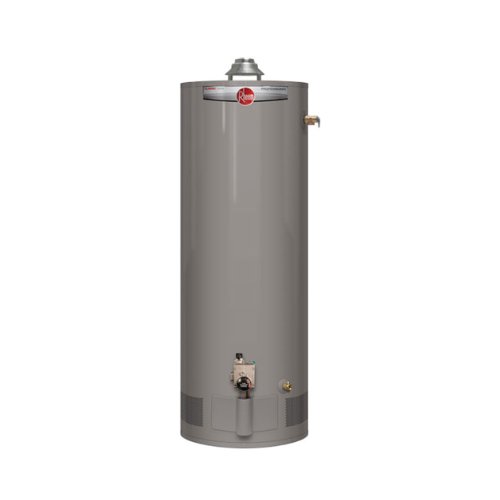
Rheem PROG50-36P 50 Gallon Propane
$1,207.00A 50 gallon gas tank built around the 36,000 BTU input used in several rows below.
Best for: Propane properties replacing an atmospheric tank
Check price on Amazon
Rheem PROE50 M2 50 Gallon
$945.99A 50 gallon electric tank illustrating a typical residential element wattage.
Best for: A straight 50 gallon electric replacement
Check price on Amazon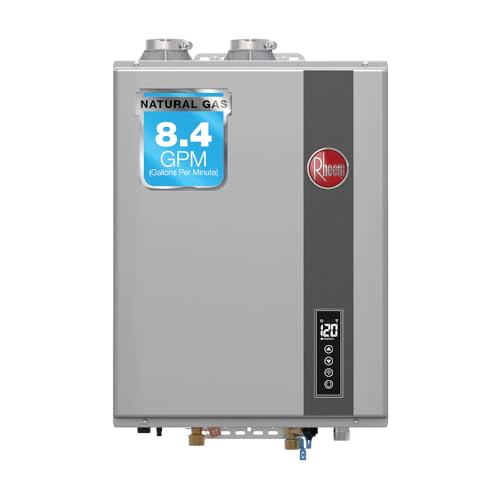
Rheem RTGH 8.4 GPM Natural Gas Indoor
$1,168.99A high-output gas tankless unit representative of the larger BTU inputs in the natural gas conversion table.
Best for: The common two to three bathroom whole house replacement
Check price on AmazonFrequently asked questions
- How many BTU does it take to heat 40 gallons of water 90 degrees?
- About 30,000 BTU total, from BTU = gallons x 8.33 x degrees F rise, or 40 x 8.33 x 90. That is the total heat required, not a rate; a burner rated exactly at 30,000 BTU per hour would need roughly one hour to accomplish this from a cold start, before accounting for standby losses and recovery efficiency.
- How do I convert a water heater's BTU rating to cubic feet of natural gas per hour?
- Divide the BTU per hour rating by about 1,030, the commonly cited average heat content of natural gas per cubic foot. A 40,000 BTU per hour water heater draws roughly 38.8 cubic feet of gas per hour at full input, a figure used directly in gas line and meter capacity sizing.
- How many kilowatts equal 40,000 BTU?
- About 11.7 kW, from dividing 40,000 by 3,412, the number of BTU in one kilowatt-hour. This conversion shows the electrical load equivalent to a given gas heat output, useful when comparing a gas appliance against an electric one delivering the same raw heating power.
- Why is propane rated in BTU per gallon instead of BTU per cubic foot?
- Propane is stored and delivered as a liquid in most residential tanks, so its energy content is conventionally expressed per gallon of liquid, about 91,500 BTU, rather than per cubic foot of vapor the way natural gas delivered through a utility pipeline is measured. Both fuels ultimately combust and release heat by the same BTU accounting once vaporized.
- Does a bigger BTU rating always mean a bigger gas line is needed?
- Yes, a higher BTU input requires more cubic feet of gas per hour, which the gas line size calculator and standard NFPA 54 / IFGC capacity tables translate into a minimum pipe diameter for a given pipe length and material. Undersizing the line for a high-BTU appliance starves it of fuel and can affect other appliances sharing that line.
- What is the difference between BTU input and BTU output on a water heater nameplate?
- Input is the raw heat rating of the burner as it consumes fuel; output is the heat actually delivered to the water after combustion and heat-exchanger losses, which is always lower than input for any combustion appliance. An electric resistance element is the exception, since its output is very close to its rated input, with almost no conversion loss.
BTU is a rate of heat, not a measure of gallons. Two water heaters with the identical BTU rating deliver very different amounts of usable hot water if their temperature rise, standby loss and recovery efficiency differ, so use the BTU figure as one input into a sizing calculation, not as a standalone shopping number.