Recovery Rate
Water Heater Recovery Rate Chart
Researched from the DOE test procedures, NFPA 54 and NEC code tables, and manufacturer specifications. Updated .
Quick answer
Recovery rate is the speed at which a storage water heater reheats water it has already given up, expressed in gallons per hour. It is the number underneath first hour rating, and it is also what determines how quickly a tank bounces back between a second and third shower run back to back.
The formula is the same physics behind every calculator on this site: heating water takes 1 BTU per pound per degree Fahrenheit of rise, water weighs 8.33 pounds per gallon, and 1 kilowatt-hour of electricity equals 3,412 BTU. Everything below follows from those three constants. The recovery rate calculator runs this math for an exact input and rise.
What is water heater recovery rate?
Recovery rate is the number of gallons a water heater can raise through a given temperature rise in one hour, expressed as gallons per hour, or GPH. It applies to the heating element or burner alone, independent of tank size, which is why the same recovery rate figure describes a 30 gallon and an 80 gallon tank that happen to share the identical element or burner.
What is the recovery rate for common gas burner sizes?
| Gas input | 60 F rise | 70 F rise | 80 F rise | 90 F rise | 100 F rise |
|---|---|---|---|---|---|
| 30,000 BTU | 45.0 GPH | 38.6 GPH | 33.8 GPH | 30.0 GPH | 27.0 GPH |
| 36,000 BTU | 54.0 GPH | 46.3 GPH | 40.5 GPH | 36.0 GPH | 32.4 GPH |
| 40,000 BTU | 60.0 GPH | 51.5 GPH | 45.0 GPH | 40.0 GPH | 36.0 GPH |
| 50,000 BTU | 75.0 GPH | 64.3 GPH | 56.3 GPH | 50.0 GPH | 45.0 GPH |
| 65,000 BTU | 97.5 GPH | 83.6 GPH | 73.2 GPH | 65.0 GPH | 58.5 GPH |
| 76,000 BTU | 114.1 GPH | 97.8 GPH | 85.5 GPH | 76.0 GPH | 68.4 GPH |
Convention Source: Calculated from GPH = (BTU/hr x 75 percent) / (8.33 x rise). 75 percent is an assumed recovery efficiency for this chart; a specific burner's published recovery efficiency governs the real figure.. Higher BTU inputs above 65,000 are typically power-vent or commercial-residential crossover models rather than standard atmospheric tanks.
What is the recovery rate for common electric element sizes?
| Element wattage | 60 F rise | 70 F rise | 80 F rise | 90 F rise | 100 F rise |
|---|---|---|---|---|---|
| 3,800 W | 25.9 GPH | 22.2 GPH | 19.5 GPH | 17.3 GPH | 15.6 GPH |
| 4,500 W | 30.7 GPH | 26.3 GPH | 23.0 GPH | 20.5 GPH | 18.4 GPH |
| 5,500 W | 37.6 GPH | 32.2 GPH | 28.2 GPH | 25.0 GPH | 22.5 GPH |
Published standard Source: Calculated from GPH = (kW x 3,412) / (8.33 x rise). Electric resistance heating converts at close to 100 percent efficiency, so no assumed efficiency factor is applied here.. A tank with two elements does not add their wattages; only the lower element runs during steady-state recovery on a standard non-simultaneous thermostat wiring setup.
How much does the assumed gas recovery efficiency actually change the answer?
The 75 percent figure used in the gas table above is an assumption, not a measurement, and different burner designs publish different recovery efficiencies. Here is how much that single assumption moves the answer for one input and rise.
| Assumed recovery efficiency | Resulting GPH |
|---|---|
| 65 percent | 34.7 GPH |
| 70 percent | 37.4 GPH |
| 75 percent | 40.0 GPH |
| 80 percent | 42.7 GPH |
| 85 percent | 45.4 GPH |
Convention Source: Calculated from GPH = (40,000 x assumed efficiency) / (8.33 x 90) at each listed efficiency value.. A 20 point swing in assumed efficiency moves this example by about 11 gallons per hour, which is enough to change which tank clears a household's peak hour demand.
Why does electric recovery rate lag gas recovery rate so much?
A 4,500 watt element converts to about 15,354 BTU per hour at essentially full efficiency, while even a modest 36,000 BTU gas burner delivers roughly 27,000 BTU per hour of net recovery heat at a typical 75 percent recovery efficiency, nearly double the electric figure. Electric tanks make up for this by relying more heavily on stored volume and, in the case of a heat pump water heater, by moving heat rather than generating it directly, which is a different mechanism from the resistance elements covered in this table.
Where does recovery rate actually matter in daily use?
Recovery rate matters most between draws, not during the first draw, since first hour rating already covers the initial full-tank scenario. A household running a shower, then a load of dishes, then a second shower within a short window is testing recovery rate directly, and a tank with a slow recovery rate can leave the third user with noticeably cooler water even though the first hour rating on the label looked adequate.
Units and the part that governs recovery
Recovery rate lives in the burner or element, not the tank shell, so a failed element restores rated recovery just as well as a new tank does.

Rheem PROE50 M2 50 Gallon
$945.99A 50 gallon electric tank built around the 4,500 watt element used throughout the electric rows below.
Best for: A straight 50 gallon electric replacement
Check price on Amazon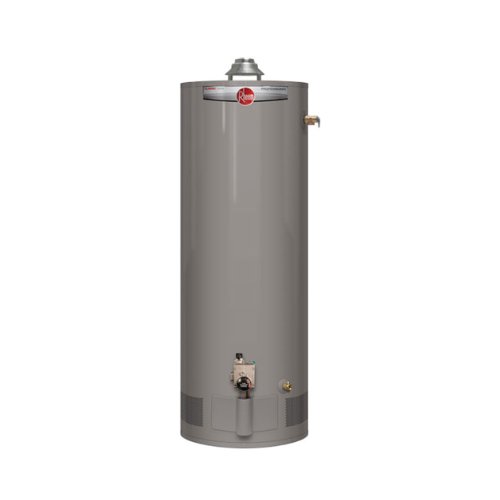
Rheem PROG50-36P 50 Gallon Propane
$1,207.00A 50 gallon gas tank built around the 36,000 BTU burner used in the gas rows below.
Best for: Propane properties replacing an atmospheric tank
Check price on Amazon
Camco 4500W 240V Foldback Element
$12.85A replacement heating element for restoring a tank's rated recovery rate after an element fails.
Best for: Hard water, where elements scale and burn out
Check price on AmazonFrequently asked questions
- What is a good recovery rate for a water heater?
- A gas water heater with a recovery rate of 35 to 40 gallons per hour at a typical 90 F rise, or an electric water heater with a recovery rate of 18 to 25 gallons per hour at the same rise, covers most households running back-to-back showers or a shower alongside a dishwasher. A household with heavier simultaneous demand benefits from a higher BTU or wattage rating in the tables above.
- Does recovery rate depend on tank size?
- No. Recovery rate depends on the burner's BTU input or the element's wattage, not on the tank's gallon capacity. A 30 gallon and an 80 gallon tank built around the identical 4,500 watt element share the same recovery rate in gallons per hour, though the larger tank's first hour rating is still higher because it starts with more stored hot water.
- Why do gas water heaters recover faster than electric ones?
- A typical 36,000 BTU gas burner delivers roughly 27,000 BTU per hour of net recovery heat at a common 75 percent recovery efficiency, compared with about 15,354 BTU per hour from a 4,500 watt electric element at close to full efficiency. The gas burner simply has more raw heating power to work with, even accounting for combustion losses electric resistance heating does not have.
- What is the formula for water heater recovery rate?
- For gas, GPH equals BTU per hour input times an assumed recovery efficiency, divided by 8.33 times the temperature rise in Fahrenheit degrees. For electric, GPH equals kilowatts times 3,412, divided by 8.33 times the temperature rise. Both formulas come from the same underlying relation that heating one pound of water one degree takes one BTU, and water weighs 8.33 pounds per gallon.
- Does replacing a failed heating element restore full recovery rate?
- Yes, as long as the replacement matches the original element's wattage rating. Recovery rate depends entirely on the element's power output, so a correctly matched replacement element restores the tank's original rated recovery rate exactly, with no change to the tank shell or insulation affecting that number.
- Why does my water heater feel slower to recover in the winter?
- Incoming cold water runs colder in winter, which increases the temperature rise the heater has to work through to reach the same delivered temperature. Since recovery rate in gallons per hour drops as temperature rise increases for a fixed BTU or wattage input, the same water heater genuinely recovers fewer gallons per hour on a cold winter day than on a warm one.
Recovery rate and first hour rating answer different questions. First hour rating tells you what a full tank can deliver once; recovery rate tells you how fast it bounces back for the second and third draw, and a household with heavy back-to-back use should weigh both numbers, not just the label figure.