Electrical
Water Heater Breaker and Wire Size Chart
Researched from the DOE test procedures, NFPA 54 and NEC code tables, and manufacturer specifications. Updated .
Quick answer
NEC 422.13 makes a storage water heater of 120 gallons or less a continuous load, which means the branch circuit has to be sized at 125 percent of the nameplate current draw rather than at the draw itself. That 25 percent margin is why a 4,500 watt element, which only draws 18.75 amps, still ends up on a 25 amp breaker instead of a 20 amp one.
This chart works that arithmetic for the common residential element ratings, using NEC Table 310.16 75 C copper ampacity and the NEC 240.4(D) small conductor overcurrent limits that cap how big a breaker 14, 12 and 10 AWG wire are allowed to carry regardless of their raw ampacity. The breaker size calculator runs this same math for a rating not listed here.
Most household circuits, a kitchen counter receptacle or a lighting circuit, are not continuous loads under the NEC and are sized straight to their ampacity without the 125 percent step. A water heater, along with a few other appliances expected to run for hours unattended, is treated differently on purpose, and skipping that extra margin is one of the more common sizing mistakes on a circuit that otherwise looks correctly matched to the appliance's nameplate current.
Why is a water heater circuit sized at 125 percent of nameplate?
NEC 422.13 defines a storage type water heater with a capacity of 120 gallons or less as a continuous load, meaning it is expected to draw current for three hours or more at a stretch. Continuous loads get a 25 percent safety margin under the NEC so the circuit does not run at its full rated capacity for hours on end. Draw comes from the element wattage and the 240 volt supply, design load is draw times 1.25, and the breaker is the next standard size at or above that design load.
| Element rating | Draw at 240 V | Design load (125%) | Breaker | Copper conductor |
|---|---|---|---|---|
| 2.5 kW | 10.4 A | 13.0 A | 15 A | 14 AWG |
| 3.5 kW | 14.6 A | 18.2 A | 20 A | 12 AWG |
| 4.5 kW | 18.8 A | 23.4 A | 25 A | 10 AWG |
| 5.5 kW | 22.9 A | 28.6 A | 30 A | 10 AWG |
| 6.5 kW | 27.1 A | 33.9 A | 35 A | 8 AWG |
| 7.2 kW | 30.0 A | 37.5 A | 40 A | 8 AWG |
| 9.0 kW | 37.5 A | 46.9 A | 50 A | 8 AWG |
| 11.0 kW | 45.8 A | 57.3 A | 60 A | 6 AWG |
| 13.0 kW | 54.2 A | 67.7 A | 70 A | 4 AWG |
Published standard Source: NEC 422.13 continuous load rule (125 percent of nameplate draw), NEC Table 310.16 75 C copper ampacity, and NEC 240.4(D) small conductor overcurrent limits.. Draw = watts divided by 240 volts. Design load = draw times 1.25. Breaker is the next standard NEC 240.6(A) size at or above the design load, and the conductor is the smallest copper size whose ampacity and 240.4(D) cap both cover that breaker.
What is the maximum breaker size for 14, 12 or 10 AWG copper wire?
NEC Table 310.16 lists a higher ampacity for 14, 12 and 10 AWG copper than the breaker they are actually allowed to sit behind, because NEC 240.4(D) caps those three sizes at a lower overcurrent protection rating regardless of the insulation's temperature rating. Above 10 AWG, the breaker is sized to the conductor's listed ampacity instead.
| Copper AWG | 75 C ampacity (NEC Table 310.16) | Maximum standard breaker |
|---|---|---|
| 14 AWG | 20 A | 15 A (240.4(D) cap) |
| 12 AWG | 25 A | 20 A (240.4(D) cap) |
| 10 AWG | 35 A | 30 A (240.4(D) cap) |
| 8 AWG | 50 A | sized to ampacity |
| 6 AWG | 65 A | sized to ampacity |
| 4 AWG | 85 A | sized to ampacity |
| 3 AWG | 100 A | sized to ampacity |
| 2 AWG | 115 A | sized to ampacity |
Published standard Source: NEC Table 310.16, 75 C copper conductor ampacity, and NEC 240.4(D) small conductor overcurrent device limits..
Does this chart apply to a heat pump water heater?
No, not for the compressor circuit. A heat pump water heater's compressor is a motor load, not a simple resistive element, so its nameplate lists a Minimum Circuit Ampacity and a Maximum Overcurrent Protection rating directly, and those two figures are what size the breaker and wire, not the draw-times-1.25 arithmetic above. A hybrid heat pump unit's electric backup resistance element, when it has one, does follow this chart's math on its own rating, separately from the compressor circuit.
Minimum Circuit Ampacity and Maximum Overcurrent Protection are standard labeling for motor-driven and mixed-load appliances precisely because a compressor's starting current, and the wiring margin a manufacturer builds in around it, do not reduce to a single wattage figure the way a resistive element does. Reading those two values straight off the data plate, rather than reconstructing them from the compressor's running wattage, is the correct method for that class of appliance.
How is a large electric tankless water heater wired differently?
Whole-home electric tankless units draw far more total current than a single tank element, often more than one standard residential breaker is rated to carry, so manufacturers split the total load across two or three separate circuits inside the unit rather than running it on one oversized breaker and cable. The table below shows the total draw at 240 volts for common tankless ratings; the specific circuit count, the amperage of each individual circuit, and the wire size for each come from that model's installation manual, not from a single lookup.
| Unit rating | Total draw at 240 V | Typical circuit split |
|---|---|---|
| 18 kW | 75.0 A | 2 to 3 circuits per installation manual |
| 24 kW | 100.0 A | 2 to 3 circuits per installation manual |
| 27 kW | 112.5 A | 2 to 3 circuits per installation manual |
| 36 kW | 150.0 A | 2 to 3 circuits per installation manual |
Published standard Source: Total draw calculated from nameplate kW divided by 240 volts. The circuit count and the breaker or wire size for each individual circuit are set by the manufacturer's installation manual, not by a universal NEC table, because manufacturers split the total load differently between models.. Do not wire one of these ratings as a single circuit off the table above; the manual's per-circuit breakdown governs, and it typically calls for two to three dedicated circuits landing inside the unit itself.
Does a larger electric tankless unit need a panel upgrade?
Frequently, yes. A single 36 kW unit alone draws 150 amps total, which is close to the entire capacity of many older 200 amp residential panels once every other circuit in the house is already accounted for. Because the load is continuous under the same NEC 422.13 logic that applies to a tank element, the panel's available capacity has to cover the full 125 percent design figure for whichever circuits the manufacturer splits the unit across, not just the raw draw. This is one of the more common reasons a whole-home electric tankless retrofit turns into a panel or service upgrade rather than a same-day swap.
What should I check before an electrician arrives?
Confirm the element or unit's nameplate wattage and voltage, whether it is a single tank element or a multi circuit tankless unit, and whether the existing panel has room for the breaker size the table above calls for. None of that replaces a load calculation for the whole panel, which accounts for every other circuit already installed.
A panel that is already close to its rated capacity, common in an older house that has added central air conditioning, an electric range or a car charger over time, can technically have an open slot for a new breaker while still lacking the actual current-carrying headroom for a large water heater or tankless circuit. That distinction, an open slot versus available capacity, is exactly what a panel load calculation checks and a slot count alone does not.
Turn the breaker off and verify it with a meter before opening a junction box or removing an element. A 240 volt circuit runs on two hot legs, and both are live even after one pole of a double pole breaker looks switched off if the breaker itself has failed. Never energize an element that is not fully submerged; a dry element burns out within seconds of power being applied.
Controls that share the circuit
A time-of-use switch or timer for an electric water heater is wired into the same circuit sized below, not a separate one, and it has to be rated for the full load it is switching. A timer does not change the breaker or wire size the element itself requires; it simply interrupts that same circuit on a schedule.

Intermatic WH21 Water Heater Timer
$69.26A water heater specific timer built to switch a 240 volt resistive load directly, without an added contactor.
Best for: A 240 volt electric tank on a time of use rate
Check price on Amazon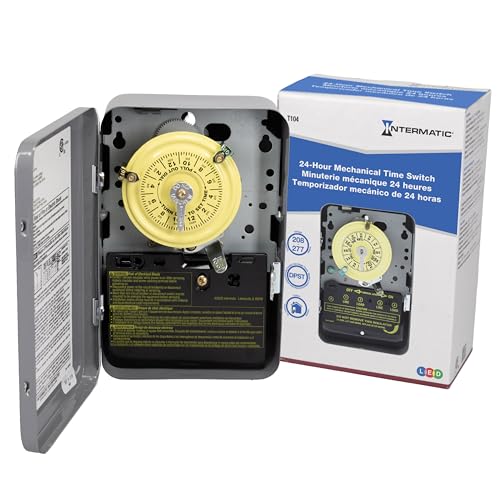
Intermatic T104 24 Hour Timer, DPST
$84.52A mechanical dial timer for a simpler installation where a programmable schedule is not needed.
Best for: A 240 volt circuit that must be fully switched
Check price on Amazon
DEWENWILS 24 Hour Mechanical Timer, 40A DPST
$58.99A double pole timer for a circuit where both legs of the 240 volt supply need to be switched together.
Best for: A standard electric tank
Check price on AmazonFrequently asked questions
- What size breaker do I need for a 4,500 watt water heater?
- A 4,500 watt element at 240 volts draws 18.75 amps. NEC 422.13 treats it as a continuous load, so the design figure is 18.75 times 1.25, or about 23.4 amps, which rounds up to a 25 amp breaker on 10 AWG copper wire under NEC Table 310.16 and NEC 240.4(D).
- What size breaker do I need for a 5,500 watt water heater?
- A 5,500 watt element at 240 volts draws about 22.9 amps. At 125 percent for the continuous load rule in NEC 422.13, that is roughly 28.6 amps, which calls for the next standard size up, a 30 amp breaker, on 10 AWG copper wire.
- Can I use 12 gauge wire for a water heater circuit?
- 12 AWG copper wire is capped at a 20 amp breaker under NEC 240.4(D), regardless of its raw ampacity. That covers a 3,500 watt element, whose 125 percent design load is about 18.2 amps, but not a 4,500 watt element or larger, which needs a 25 amp breaker and steps up to 10 AWG.
- What size wire does a 4,500 watt water heater need?
- 10 AWG copper wire, sized for the 25 amp breaker a 4,500 watt element requires. That element draws 18.75 amps, which becomes about 23.4 amps once NEC 422.13's 125 percent continuous load factor is applied, and 10 AWG is the smallest conductor whose NEC 240.4(D) cap covers a 25 amp breaker.
- Why is a water heater treated as a continuous load under the NEC?
- NEC 422.13 classifies a storage water heater of 120 gallons or less as a continuous load because it is expected to draw current for three hours or longer without stopping while recovering a full tank. Continuous loads get a 25 percent safety margin on the circuit, which is why the breaker and wire are always sized above the element's raw current draw.
- Does an 18 kW electric tankless water heater need just one breaker?
- No. An 18 kW unit draws 75 amps total at 240 volts, more than a single standard residential breaker is meant to carry continuously, so manufacturers split that load across two to three dedicated circuits inside the unit. The exact circuit count and the breaker size for each one come from that model's installation manual.
This chart sizes the water heater's own circuit, not the whole panel. A qualified electrician still has to confirm the panel has capacity left after every other circuit is accounted for. Turn the breaker off and verify it is dead before any element work, and never energize an element that is not fully submerged in water.