Pressure & Expansion
Why Your Water Heater Relief Valve Drips
Researched from the DOE test procedures, NFPA 54 and NEC code tables, and manufacturer specifications. Updated .
Quick answer
A temperature and pressure relief valve, almost always shortened to T&P valve, is the single safety device standing between a water heater and a tank that cannot vent excess pressure or excess heat. It is designed to open and discharge water when either pressure or temperature inside the tank exceeds its rated setting, commonly 150 psi and 210 F. A T&P valve that drips is doing exactly what it is built to do: telling you something upstream of it is pushing pressure or temperature past a threshold it is not supposed to cross under normal operation.
There are only three real causes behind a dripping valve, and they point to three completely different fixes. Confusing them is how people end up replacing a valve three times in as many years without ever addressing the actual cause, or worse, capping the discharge pipe because the dripping is annoying. This page walks through how to tell the three apart using nothing more than a pressure gauge and a bit of patience.
What does a T&P valve actually do?
A T&P valve is a spring-loaded relief device threaded into the top or upper side of a water heater tank, with a discharge pipe routed down toward the floor. It opens automatically if either tank pressure exceeds its rated setting, typically 150 psi, or tank temperature exceeds its rated setting, typically 210 F, whichever happens first. Under those conditions a sealed tank can otherwise build pressure with nowhere to go, and the ASME requirements this valve is built to exist specifically to prevent that outcome.
A valve that opens and closes on its own during ordinary operation, releasing a small amount of water each time, is discharging exactly as designed in response to pressure or temperature briefly crossing its threshold. That is not the valve malfunctioning; it is the valve doing its one job. The question worth answering is what is pushing pressure or temperature that high in the first place.
Cause one: thermal expansion with no expansion tank
If your water supply is a closed system, meaning a check valve, pressure-reducing valve, or backflow preventer sits somewhere upstream and prevents water from pushing back out toward the street main, then heated water inside the tank has nowhere to expand into except the T&P valve. Water expands measurably as it heats from a cold fill temperature toward a typical 120 to 140 F setpoint, and in a closed system with no expansion tank, that expansion raises tank pressure directly. If that pressure rise crosses the valve rated setting, even briefly at the peak of a heating cycle, the valve opens and drips.
This is by a wide margin the most common cause of an otherwise-fine valve dripping on a schedule tied to heating cycles, particularly right after recovery from a large hot water draw. The fix is a correctly sized, correctly pre-charged expansion tank on the cold inlet, never removing or restricting the valve.
Cause two: static supply pressure is already too high
If static supply pressure, meaning pressure measured at a hose bibb with no fixtures running, already sits close to or above the valve rated setting before the water heater has even fired, an expansion tank cannot fully solve the problem because there is too little headroom left for expansion to work with. High static pressure is often a municipal supply issue, a failed or absent pressure-reducing valve on the main, or elevation and distance from a booster pump. In this case the correct fix is a pressure-reducing valve installed by a licensed plumber to bring static supply pressure down into a normal residential range, after which an expansion tank can do its job on the remaining thermal expansion.
Cause three: the valve itself has failed
A T&P valve is a mechanical device with a spring and a seat, and like any mechanical device it can fail, most often from mineral scale building up on the seat and preventing a full reseal after it opens, or from age simply wearing the spring past its rated tolerance. A valve that drips continuously rather than in response to a heating cycle, or one that drips even when static pressure and expansion tank pre-charge both check out normal, is more likely a failed valve than an upstream pressure problem. Manufacturers do not publish a fixed replacement interval; a valve is replaced when it fails a manual test or shows continuous discharge that pressure and expansion checks cannot explain.
How do I tell the three apart with a pressure gauge?
| What the gauge shows | Likely cause | Fix |
|---|---|---|
| Static pressure normal (40 to 60 psi), rises sharply during a heating cycle | Thermal expansion, no expansion tank or a failed one | Install or replace expansion tank, set pre-charge to static pressure |
| Static pressure already high (75 psi or more) before heating | High supply pressure, expansion tank alone cannot fix it | Pressure-reducing valve fitted by a licensed plumber |
| Static and post-heating pressure both normal, valve still drips | Valve has failed or is scaled at the seat | Replace the T&P valve |
Published standard Source: ASME T&P valve rated settings (typically 150 psi / 210 F) and standard hose bibb pressure gauge diagnostic practice.. Take the "post-heating" reading right after a full recovery cycle, not hours later once the tank has cooled and pressure has relaxed back down.
What should I never do about a dripping valve?
Never cap, plug, remove, or install a shutoff valve anywhere in the T&P discharge line. A capped or removed relief valve does not make the underlying pressure or temperature problem go away, it removes the one device standing between a sealed tank under rising pressure and a tank that has no way to relieve it, which is a genuine hazard. The discharge pipe itself should run to within six inches of the floor, be full size with no reduction, have no threads on its open end, and have no upward run anywhere in its path, since a T&P valve is a safety device and its discharge path is part of that safety design, not an incidental detail.
Never cap, plug, or remove a T&P valve, and never install a valve in its discharge line. If it drips, the fix is an expansion tank, a pressure-reducing valve, or a new T&P valve, in that order of diagnosis, never a way to stop the drip without addressing the cause.
Parts for a correct fix, once you know the cause
Buy the part that matches the cause you have confirmed with a gauge, not the part that is easiest to order first.
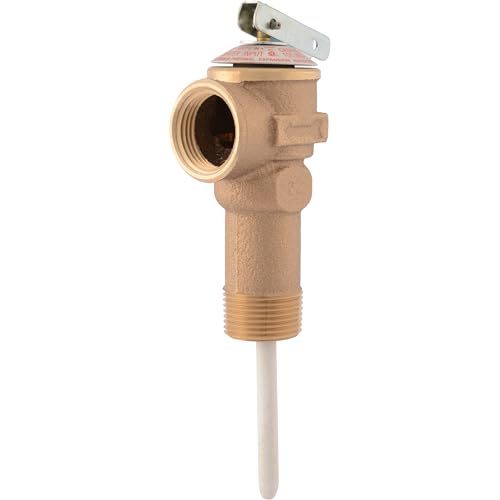
Cash Acme NCLX-5L 3/4 in T&P Valve
$25.98A standard replacement T&P valve for when the valve itself has failed, matched by pressure and temperature rating to most residential tanks.
Best for: A direct replacement on most residential tanks
Check price on Amazon
Amtrol ST-5 2 Gallon
$77.99The fix for thermal expansion on a closed system, sized for a standard 40 to 50 gallon household tank once static pressure is confirmed normal.
Best for: Anyone who wants the name plumbers recognise
Check price on AmazonFrequently asked questions
- Why does my water heater relief valve drip after a hot water heating cycle?
- The most common cause is thermal expansion in a closed water system with no expansion tank, or one with a pre-charge that no longer matches static supply pressure. As stored water heats, it expands, and with nowhere for that expansion to go, tank pressure briefly crosses the valve rated setting, commonly 150 psi, and the valve opens to relieve it.
- Is it safe to cap a dripping T&P valve?
- No, never. A T&P valve is the safety device that relieves excess pressure or temperature in a sealed tank. Capping, plugging, or removing it removes that protection entirely and leaves the tank with no way to vent a genuine overpressure or overtemperature condition, which is a real hazard rather than a cosmetic annoyance.
- How do I know if high water pressure is causing my relief valve to drip?
- Measure static pressure at a hose bibb with no fixtures running, using a simple screw-on gauge. If that reading already sits close to or above the valve rated setting, typically 150 psi, before the heater has even fired, static pressure is too high for an expansion tank alone to fix, and a pressure-reducing valve is the answer.
- Will an expansion tank stop my T&P valve from dripping?
- It will, provided the system is closed by a check valve or pressure-reducing valve upstream, the tank is correctly sized for your water heater, and its pre-charge is set to match static supply pressure before installation. If static pressure is already too high on its own, an expansion tank alone will not be enough.
- How do I know if my T&P valve itself has failed?
- If static supply pressure and expansion tank pre-charge both check out normal with a gauge, yet the valve still drips continuously rather than only during heating cycles, the valve itself has likely failed, often from mineral scale preventing a full reseal at the valve seat. Replace it with a like-rated T&P valve.
- What temperature and pressure does a T&P valve open at?
- Most residential T&P valves are rated to open at approximately 150 psi or 210 F, whichever threshold is reached first, per ASME requirements for relief valves on water heaters. Check the specific rating stamped on your valve, since some commercial or specialty units are rated differently.
Diagnose with a gauge before you buy a part. A dripping T&P valve is never fixed by capping it; it is fixed by an expansion tank, a pressure-reducing valve, or a new valve, whichever the pressure readings actually point to.