Safety
How to Test a T&P Valve
Researched from the DOE test procedures, NFPA 54 and NEC code tables, and manufacturer specifications. Updated .
Quick answer
The temperature and pressure relief valve, T&P valve for short, is a water heater's last line of defense against a tank that overheats or overpressurizes. It is a spring-loaded valve, required by plumbing code and by the ASME safety standard the valve itself is built to, that opens automatically if tank temperature exceeds about 210 F or pressure exceeds about 150 psi, either of which can otherwise turn a water heater tank into a serious hazard. A T&P valve that has silently stopped working is not a small maintenance item on the level of a squeaky drain valve. It is the difference between a tank that has an actual last line of defense and one that only appears to.
Testing it takes under a minute and manufacturers commonly recommend doing it every six months to a year, yet it is one of the most skipped items on a home maintenance list precisely because most valves sit quietly for years without ever visibly doing anything.
How do I test a T&P valve, step by step?
- Locate the valve, mounted on the side or top of the tank, and follow its discharge pipe down to where it terminates, usually near the floor.
- Place a bucket or container under the end of the discharge pipe to catch the water the test releases.
- Lift the valve's test lever fully to its open position and hold it briefly, then let it snap back down on its own.
- Watch for a strong, clear discharge of hot water, and sometimes a burst of steam, out of the end of the discharge pipe while the lever is held open.
- After releasing the lever, confirm the valve reseats completely, meaning the discharge stops fully rather than continuing as a drip or a trickle.
- If the valve produced no discharge at all, or continues dripping after the lever is released, the valve needs to be replaced. Do not attempt to open, clean, or repair the valve's internal mechanism.
What does it mean if nothing comes out, or it will not stop dripping?
No discharge at all when the lever is lifted usually means mineral deposits have seized the valve's internal mechanism shut, which is the more dangerous of the two failures, since a seized valve gives no protection at all if the tank ever does overheat or overpressurize. A valve that discharges but will not fully reseat is failing in the opposite direction: a worn seat or debris caught in the valve keeps it weeping continuously, which wastes water and, over time, can mineral-scale the valve itself into eventually seizing shut too.
Either failure has the same answer. A T&P valve is not a serviceable part with an internal repair kit; it is inexpensive, it is designed to be swapped as a whole unit, and a valve that fails a test should be replaced with a new one rather than left in place on the assumption that it might still work when it matters.
A T&P valve must never be capped, plugged, blocked, or left uninstalled without an immediate replacement threaded in. If it fails a test, the tank has no working overpressure or overtemperature protection until a new valve is in place.
How do I replace a T&P valve that failed its test?
- Turn off power to an electric tank at the breaker, or set a gas tank's control valve to pilot, and close the cold water supply valve.
- Open a hot tap to relieve pressure, then drain a few gallons through the tank's drain valve to bring the water level below the T&P valve's port.
- Disconnect the discharge pipe from the old valve, then use a pipe wrench to unthread the valve itself from the tank.
- Apply pipe thread sealant rated for potable water to the new valve's threads and thread it into the tank's port, orienting the sensing probe so it extends into the tank as designed.
- Reattach a discharge pipe, sized to match the valve's outlet, running it to within about six inches of the floor with no threads, no valve, and no upward run anywhere along its length.
- Close the drain valve, refill the tank fully, purge air at a hot tap until the stream runs steady, and restore power or return the gas control valve to normal.
- Test the new valve's lever once the tank is back up to temperature to confirm it discharges and reseats correctly.
What are the actual code requirements for a T&P valve's discharge pipe?
| Requirement | Specification | Basis |
|---|---|---|
| Pressure setting | Set to open at or below 150 psi | ASME/ANSI Z21.22 valve standard |
| Temperature setting | Set to open at or below 210 F | ASME/ANSI Z21.22 valve standard |
| Discharge pipe termination height | Within about 6 inches of the floor or the flood level of the drain it terminates at | Uniform Plumbing Code / International Plumbing Code |
| Discharge pipe threads and valves | None permitted anywhere in the discharge line | Uniform Plumbing Code / International Plumbing Code |
| Discharge pipe direction | No upward sections; must run to termination without trapping water | Uniform Plumbing Code / International Plumbing Code |
Published standard Source: ASME/ANSI Z21.22 valve manufacturing standard and the discharge piping requirements common to the Uniform Plumbing Code and International Plumbing Code.. Local code amendments vary by jurisdiction; confirm the exact discharge pipe material and routing rules with the authority having jurisdiction before installing.
How often should I test my T&P valve, and does testing wear it out?
Manufacturers commonly recommend testing every six months to a year, the same rhythm as checking smoke detector batteries, and for a similar reason: it is the only way to know a safety device still works before an emergency is the first time it is asked to. Lifting the test lever briefly does not meaningfully wear the valve; leaving it stuck open for an extended period, or testing it far more often than recommended, is unnecessary rather than harmful in moderation.
A valve that drips occasionally right after a test, for a few seconds as it reseats, is normal. A valve that continues a steady drip minutes later, or every time the tank runs a heating cycle with no test involved, is failing and should be replaced rather than watched.
Replacement valves worth comparing
A T&P valve that fails a test is swapped, not repaired. These are standard residential replacements to compare on outlet size and mounting orientation.

Camco 10453 Lead Free T&P Valve
$27.94A standard replacement T&P valve sized for most residential tanks, the straightforward swap for a valve that failed a lever test.
Best for: Hard water areas
Check price on Amazon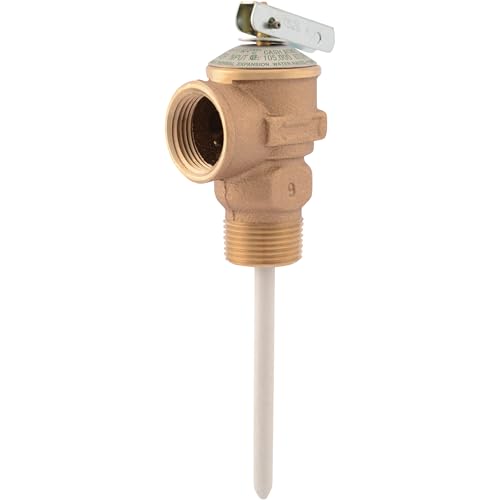
Cash Acme NCLX-5 150 psi T&P Valve
$22.12An alternative T&P valve worth comparing on outlet size and mounting orientation against the Camco.
Best for: Tanks with a shallow T&P tapping
Check price on Amazon
Camco Automatic T&P Valve with Lever
$16.27A T&P valve variant built around an automatic reset behavior, worth checking compatibility with your tank's existing port before buying.
Best for: Anyone who intends to actually test the valve
Check price on AmazonFrequently asked questions
- What should happen when I test my water heater's T&P valve?
- Lifting the test lever should release a strong burst of hot water, and sometimes steam, out of the discharge pipe while the lever is held open. When you let go, the valve should reseat completely within a few seconds, meaning the flow stops entirely rather than continuing as a drip. Either no discharge or a continued drip means the valve has failed and needs replacing.
- Is it normal for a T&P valve to drip after testing?
- A brief drip lasting a few seconds right after the lever is released, as the valve reseats, is normal. A steady, ongoing drip that continues well after the test, or that shows up between tests with the lever never touched, means the valve is not sealing properly and should be replaced rather than left in place.
- Can I repair a T&P valve instead of replacing it?
- No. A T&P valve is a sealed safety device, not a serviceable part with an internal repair kit, and it is inexpensive enough that manufacturers design it to be replaced as a whole unit. A valve that fails a test should be swapped for a new one rather than opened up or cleaned.
- Where should a T&P valve's discharge pipe end?
- The discharge pipe should terminate within about six inches of the floor or the flood level of the drain it empties into, with no threads, no valve, and no upward sections anywhere along its length, per the discharge piping requirements common to the Uniform Plumbing Code and International Plumbing Code. A pipe that traps water or points upward defeats the valve's purpose.
- What pressure and temperature does a T&P valve open at?
- Standard residential T&P valves are built to the ASME/ANSI Z21.22 standard to open at or below 150 psi of pressure or 210 F of temperature, whichever threshold is reached first. This dual protection covers both an overpressurized closed system and a tank that has overheated due to a control failure.
- How often should I test my T&P valve?
- Manufacturers commonly recommend testing every six months to a year, similar in spirit to checking a smoke detector. Lifting the lever briefly does not meaningfully wear the valve, and it is the only reliable way to confirm the valve will actually work before an emergency becomes the first real test of it.
A T&P valve that fails a lever test is replaced immediately, never capped or left in place. The discharge pipe belongs within about six inches of the floor, with no threads, no valve, and no upward run anywhere along it.