Troubleshooting
Water Heater Leaking from the Top
Researched from the DOE test procedures, NFPA 54 and NEC code tables, and manufacturer specifications. Updated .
Quick answer
Water appearing near the top of a water heater sends most people straight to worrying about the tank itself, but the tank's steel shell is only one part of what is up there. The cold inlet, the hot outlet, the T&P valve and the anode rod all thread into ports at the top of the tank, and every one of those threaded connections is a place water can find its way out without the tank shell being involved at all.
Tracing the moisture to its actual source, rather than assuming the worst, is what separates a five-minute fix from an unnecessary tank replacement.
Why does a leak from the top usually not mean the tank has failed?
The steel shell of a water heater is a sealed vessel, and the only openings into it are the threaded ports where the cold inlet, the hot outlet, the T&P valve and the anode rod each connect. Every one of those fittings relies on threads, washers or Teflon tape to seal against a pressurized tank, and any of them can loosen, corrode or wear out on its own, independent of whether the tank shell itself is sound. That is why tracing a top leak to its actual point of origin, rather than assuming the whole tank is done, is worth the few extra minutes.
Where is the water actually coming from?
Trace the moisture uphill to its source before assuming the worst; water can run down the tank's side from a fitting well above where it first appears.
| Where the moisture is | Likely source | Is it repairable? |
|---|---|---|
| Dripping from the T&P valve's discharge pipe | The T&P valve responding to pressure or temperature, or a valve that has worn out | Yes, address the pressure cause or replace the valve |
| Wet at the cold inlet or hot outlet fitting | A loose or corroded nipple connection | Yes, tighten or replace the fitting and its connector |
| Wet around the anode rod access port | A loose or under-torqued anode rod, or a worn seal at that port | Yes, reseat or replace the rod and its thread seal |
| Condensation only, no active dripping | Cold incoming water condensing on a tank surface, common when a tank first fills or in humid conditions | Not a leak; clears on its own once the tank equalizes |
Convention Source: Common residential tank water heater construction, in which the T&P valve, the inlet and outlet nipples, and the anode rod share threaded ports at the top of the tank.. Dry the suspected area completely, wait, and check again to rule out a one-time splash or condensation before concluding an active leak is present.
What does a weeping T&P valve actually mean?
A T&P valve opens automatically when either pressure or temperature inside the tank exceeds its rated threshold, releasing water to protect against a far more serious failure. A valve that weeps regularly, rather than only during an occasional spike, usually points to excess thermal expansion in a closed plumbing system, excess static supply pressure, or a worn valve that no longer reseats properly. The compare page on expansion tanks versus pressure reducing valves works through telling those pressure causes apart.
A T&P valve should never be capped, plugged or removed, whatever is causing it to weep. It is the last line of defense against a tank building dangerous pressure. The correct response to a weeping valve is fixing the pressure cause, or replacing the valve itself if it has simply worn out.
How do you check a loose inlet or outlet connection?
Dry the area around each fitting completely, run the tank through a normal cycle, and watch the threads for new moisture rather than judging from a single glance. Heat trap nipples at the cold inlet and hot outlet, which reduce standby heat loss by limiting convection up the pipe, are a common source of a persistent weep if the internal washer has failed or the fitting was never fully seated. Tighten only enough to stop the drip; overtightening a nipple with a plastic-lined fitting can crack it rather than seal it.
What about the anode rod access port?
A sacrificial anode rod threads into a port at the top of the tank, which on many residential models is combined with the hot outlet fitting rather than a separate opening. A rod that was not torqued down fully, or a thread seal that has degraded over the rod's service life, can weep at that same port. Checking and replacing the anode rod is routine maintenance in its own right, covered fully in the guide on replacing one, and a weep at this specific location is often resolved the same time the rod itself is checked. Clearance above the tank matters here too: a combination anode and hot outlet fitting needs enough straight vertical room above it to draw the old rod out in one piece, and a tank installed tight against a low ceiling or joist sometimes needs a segmented, flexible anode rod to service that same port without cutting into the surrounding framing.
Does a persistent fitting leak ever damage the tank around it?
A slow drip that goes unnoticed for a long stretch can leave the metal around a fitting damp continuously, and continuous moisture at the top plate of a tank, or around the flue collar on an atmospheric vent gas model, can encourage surface rust on the metal near the leak even while the tank's own shell stays sound underneath. That rust is a sign the leak has been present longer than it should have been, not evidence the tank itself is failing, but it is a reason to fix a known weeping fitting promptly rather than leaving it to drip indefinitely once it has been identified.
When does a leak from the top actually mean the tank has failed?
It is uncommon, but if a traced wet path leads to a seam in the tank's steel shell itself, rather than to any threaded fitting, that is a shell failure equivalent to a leak from the bottom, and it is not repairable. The distinction matters: nearly every top leak traces back to a fitting rather than the shell, so ruling out the fittings first, using the table above, is worth doing before concluding the tank itself is done.
Fittings and parts for a top leak
Match the part to the specific fitting the leak traces back to; the table below narrows that down first.
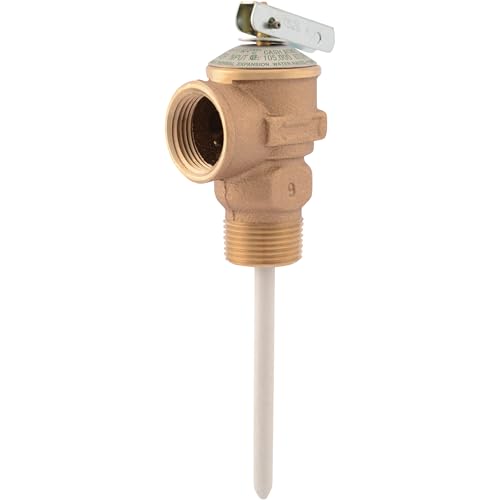
Cash Acme NCLX-5 150 psi T&P Valve
$22.12A direct replacement temperature and pressure relief valve for a unit that continues weeping after the pressure cause has been addressed.
Best for: Tanks with a shallow T&P tapping
Check price on Amazon
Eastman Dielectric Heat Trap Nipples, Pair
$11.64Replacement heat trap nipples for the cold inlet and hot outlet connections, a common source of a persistent weep at those threads.
Best for: Every tank replacement with copper pipe
Check price on Amazon
Eastman 42 in Flexible Magnesium Anode
$35.25A standard replacement anode rod for reseating or replacing at the top port if that connection is the source.
Best for: A tank with a low ceiling above it
Check price on Amazon
Element Socket Set, 27 mm and 38 mm
$15.99A socket set sized for the anode rod and fitting nuts involved in accessing the top of the tank.
Best for: Not knowing which size the tank takes
Check price on AmazonFrequently asked questions
- Is a leak from the top of a water heater serious?
- It is worth addressing promptly, but it is rarely a sign the tank itself has failed. Most top leaks trace to a specific fitting, the T&P valve, the inlet or outlet connections, or the anode rod port, all of which are repairable without replacing the tank. Tracing the moisture to its actual source before assuming the worst usually turns this into a straightforward fix.
- Why is my water heater's T&P valve dripping?
- A T&P valve that weeps regularly is usually responding to excess pressure, either from thermal expansion in a closed plumbing system or from high static supply pressure, or the valve itself has simply worn out and no longer reseats. Addressing the pressure cause, or replacing a worn valve, resolves it. The valve should never be capped or removed as a shortcut.
- Can I just tighten a leaking water heater fitting myself?
- For a loose inlet, outlet or anode port connection, tightening carefully, just enough to stop the drip, is a reasonable homeowner task. Overtightening a fitting with a plastic-lined nipple can crack it instead of sealing it, so stop as soon as the drip resolves rather than continuing to tighten further.
- What is a heat trap nipple and can it leak?
- A heat trap nipple is a fitting installed at the cold inlet and hot outlet that limits convective heat loss up the pipe when the tank is idle, improving standby efficiency. Like any threaded fitting, it can weep if its internal washer fails or it was not fully seated during installation, and replacing it resolves that specific leak.
- Is condensation on top of my water heater a leak?
- Not necessarily. Condensation forms when cold incoming water cools a tank surface below the surrounding air's dew point, most common right after a tank fills or in a humid space, and it clears on its own as the tank equalizes with room temperature. An active drip that continues after drying the area is a genuine leak; a film that reappears without dripping is more likely condensation.
- Does a leak from the top mean I need a new water heater?
- Rarely. Nearly every top leak traces to a specific fitting rather than the tank shell itself, and fittings are repairable or replaceable without touching the tank. A new water heater becomes the answer only if the traced source turns out to be a seam in the shell itself, which is uncommon for a top leak specifically.
Trace before you replace. A dry area, a normal heating cycle, and a close look at each fitting in the table above tell you which part is actually weeping, and most of what is up there is a repairable fitting rather than a failed tank.