Pressure & Expansion
The Tankless Cold Water Sandwich, Explained
Researched from the DOE test procedures, NFPA 54 and NEC code tables, and manufacturer specifications. Updated .
Quick answer
A tankless water heater has no stored hot water buffer the way a tank unit does, which is the source of both its main advantage and this specific quirk. It fires its burner or elements only while water is actively flowing through it, and the moment flow stops, even briefly, the unit shuts down. If flow resumes within a short window, most units take a brief moment to detect the resumed flow and restart, and during that restart window the water sitting in the pipe between the unit and the fixture, which has had a moment to cool, arrives at the fixture as a noticeably cold slug sandwiched between two stretches of hot water. This is the "cold water sandwich" effect, named for the cold layer appearing in the middle of what should be a continuous hot draw.
It happens most reliably in a specific scenario: a shower valve briefly switched off and back on, two fixtures used in quick succession on the same tankless unit, or a washing machine cycling its fill valve on and off. This page explains the mechanism, what specifically mitigates it, and why adding a recirculation loop changes the picture rather than simply eliminating the effect outright.
What exactly causes the cold water sandwich?
The sequence starts with a pause in flow, however brief, through the tankless unit: a shower valve turned off momentarily, a second fixture opened that momentarily interrupts flow through the first, or an appliance fill valve cycling. A tankless unit reads flow through an internal flow sensor and only fires its burner or elements above a minimum activation flow rate. When flow drops below that threshold, even for a second, the unit shuts its heating off. The pipe run between the unit and the fixture retains water that was already heated, but that water begins cooling immediately once flow and heating both stop.
When flow resumes, the unit's flow sensor and ignition sequence take a brief moment, commonly a couple of seconds, to detect resumed flow, ignite, and reach target temperature again. During that restart window, the water already sitting in the pipe, now cooled from sitting still, reaches the fixture first, arriving as a cold slug sandwiched between the hot water delivered before the pause and the hot water that resumes once the unit relights.
Why does this not happen with a tank water heater?
A storage tank water heater keeps a large volume of already-heated water on hand at all times, so a brief pause and restart in draw does not require the heating source to relight or the flow sensor to redetect anything, since the tank was never off in the first place, only static. The hot water already sitting in the tank continues to be available the instant flow resumes. This is a structural tradeoff of tankless technology rather than a defect in any specific unit: the same on-demand design that eliminates standby heat loss and gives continuous hot water on a long draw is what creates a restart gap on a short interrupted one.
Which unit characteristics reduce the cold water sandwich?
| Characteristic | Effect on cold sandwich |
|---|---|
| Low minimum activation flow rate | Fewer brief flow dips fall below the threshold that shuts the burner off |
| Fast flow-sensing and ignition electronics | Shorter restart window, so less cooled water reaches the fixture before hot resumes |
| Small internal buffer tank (on some models) | A small reserve of hot water smooths the restart gap without full tank storage |
| Long pipe run between unit and fixture | Worsens the effect, since more standing water has time to cool during the pause |
| Point-of-use unit installed close to the fixture | Reduces standing pipe volume, which shortens and can eliminate a noticeable cold slug |
Convention Source: Compiled from manufacturer published minimum activation flow rates, ignition response specifications, and the consensus of verified owner reviews describing restart behavior.. Manufacturers do not universally publish an exact restart time in seconds, so treat faster ignition response as a directional advantage rather than a guaranteed fixed number.
How does a recirculation loop change the behavior?
A recirculation system continuously or intermittently circulates water through the hot water line back to the water heater, which keeps the pipe run between the unit and the fixtures pre-warmed rather than sitting cold or cooling between draws. On a tankless unit paired with recirculation, the effect on the cold water sandwich is less about eliminating the tankless unit's restart behavior and more about changing what water is sitting in the pipe when a pause happens: instead of cooled standing water, the line already holds warm water, so a brief interruption in draw does not produce the same noticeable cold slug.
Recirculation requires a tankless unit specifically rated to support it, since continuous or frequent low-flow circulation can fall below a standard unit's minimum activation flow rate and either fail to fire or short-cycle the unit. Compare tankless units against a recirculation pump's specifications, and see the recirculation pump calculator to size the pump and loop for the unit and pipe run involved.
Is the cold water sandwich a sign something is wrong with my unit?
Not on its own. A brief cold slug after a short pause and restart in draw is a known characteristic of on-demand heating rather than evidence of a fault, and it appears to some degree on nearly every tankless unit under the right sequence of interrupted flow. It becomes worth investigating as a possible fault, rather than an inherent characteristic, if the cold period is unusually long, happens on every single draw without any pause at all, or is accompanied by an error code, any of which point toward a flow sensor, igniter, or gas supply issue rather than the ordinary restart gap described here.
What actually mitigates the cold water sandwich
Not every tankless unit handles this the same way. Some pair a small internal buffer tank with fast flow-sensing electronics specifically to shorten or eliminate the gap.
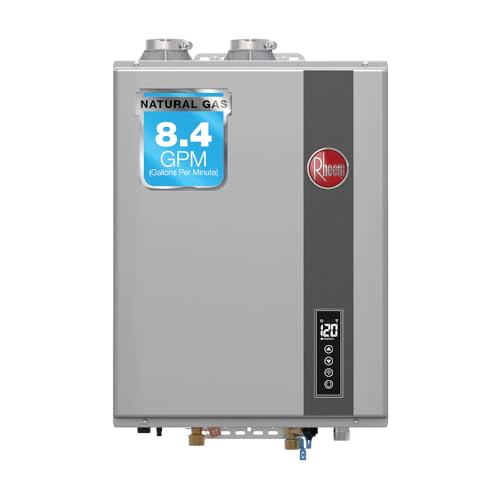
Rheem RTGH 8.4 GPM Natural Gas Indoor
$1,168.99A condensing tankless unit with fast-responding electronics aimed at shortening the flow-detection restart window that produces the cold slug.
Best for: The common two to three bathroom whole house replacement
Check price on Amazon
Rinnai RX130iN Condensing
$1,264.20A unit built with a low minimum activation flow rate, which reduces how often a brief pause in draw drops below the threshold that shuts the burner off in the first place.
Best for: Households that run short, repeated draws
Check price on Amazon
Grundfos Comfort System 595916
$334.98A recirculation pump that keeps the line between the unit and fixtures pre-warmed, which changes the cold sandwich problem into a near-instant hot start instead.
Best for: A retrofit with no dedicated return line
Check price on AmazonFrequently asked questions
- What is a cold water sandwich on a tankless water heater?
- It is a slug of noticeably cold water that reaches the fixture after a brief pause and restart in hot water draw, sandwiched between the hot water delivered before the pause and the hot water that resumes once the unit relights. It happens because the unit shuts its burner off during any flow interruption and takes a moment to detect and restart flow.
- Does every tankless water heater have the cold water sandwich problem?
- To some degree, yes, since it stems from the fundamental on-demand design of tankless heating rather than a defect in any one unit. Units with a lower minimum activation flow rate, faster flow-sensing electronics, or a small internal buffer tank reduce how noticeable and how long the effect is, but none eliminate the underlying mechanism entirely without a buffer tank or recirculation.
- Does a recirculation pump fix the cold water sandwich?
- It changes the problem rather than eliminating the tankless unit's restart behavior. A recirculation loop keeps the pipe run between the unit and the fixtures pre-warmed, so a brief flow interruption does not draw cooled standing water, which is what makes the sandwich noticeable in the first place.
- Why is the cold water sandwich worse in my upstairs bathroom?
- A longer pipe run between the tankless unit and a distant fixture holds more standing water, which has more time to cool during any pause in flow. A point-of-use unit installed close to the fixture, or a recirculation loop that keeps the long run pre-warmed, both reduce the effect for a distant fixture specifically.
- Should I worry that my tankless unit has a cold water sandwich?
- A brief cold slug after an interrupted draw is an expected characteristic of on-demand heating, not usually a fault. It is worth investigating as a possible problem if the cold period is unusually long, happens on every draw with no pause at all, or comes with an error code, any of which suggest a flow sensor or ignition issue instead.
- Does a tank water heater have a cold water sandwich?
- No, not in the same way. A storage tank keeps a large volume of already-heated water on hand continuously, so a brief pause and restart in draw does not require any heating source to relight or any flow sensor to redetect flow, since the stored hot water was never off in the first place.
The cold water sandwich is a restart gap, not a fault. A shorter pipe run, a unit with fast flow-sensing electronics, or a recirculation loop all shrink or change it, but expecting it to vanish from tankless heating entirely misunderstands what makes it on-demand in the first place.