Plumbing
Hot Water Recirculation, Explained
Researched from the DOE test procedures, NFPA 54 and NEC code tables, and manufacturer specifications. Updated .
Quick answer
Without recirculation, hot water sits still in the pipe between draws, and whatever water is in that pipe cools to room temperature over time. The next time a tap is opened, that cooled water has to be pushed out and replaced with genuinely hot water from the tank before the tap actually runs hot, and on a long pipe run that wait can stretch to a minute or more, wasting the water that ran cold the whole time down the drain.
Recirculation solves the wait by keeping water moving, either continuously or on a schedule, through a loop that returns to the water heater rather than dead-ending at the farthest fixture. The water in that loop stays close to tank temperature at all times, so the moment a tap opens, hot water is already right there. The cost of that convenience is that the loop is now losing heat to its surroundings for every hour it circulates, not just the moment someone opens a tap, which is standby loss spread across a length of pipe instead of concentrated inside a tank.
What is the actual difference between a dedicated return line and a crossover valve?
A dedicated return line is a genuinely separate pipe, installed alongside the hot water line, that carries water from the farthest fixture back to the water heater in a true loop, with the pump moving water in one continuous circuit. This is the cleanest system, since hot water only ever moves in the intended direction, but it usually only exists in homes plumbed for it from the start or where a remodel opened up the walls enough to add it.
A crossover valve is the retrofit path for a home with no dedicated return line: a small valve installed under the sink at the fixture farthest from the water heater, connecting the hot and cold lines together at that one point. A pump, usually mounted at the water heater, pushes hot water out to that valve, and the valve lets it cross over into the cold line to travel back, using the existing cold water pipe as the return path instead of a pipe installed for the purpose. It is far less invasive to install, and it is the more common recirculation setup in existing homes for exactly that reason, though it does mean the cold line briefly carries warm water during each circulation cycle.
Why does a timer and a thermostat matter more than the pump itself?
A recirculation pump left running continuously, with no control beyond an on and off switch, keeps the loop hot around the clock, which maximizes the standing heat loss this whole system trades for convenience. A thermostat, usually called an aquastat on these pumps, solves half of that by only running the pump when the water in the loop has actually cooled below a set threshold, rather than running it constantly regardless of loop temperature. A timer solves the other half by restricting circulation to the hours the household actually wants instant hot water, typically mornings and evenings, rather than through the overnight hours when nobody is drawing water at all.
Together, an aquastat and a timer are what keep a recirculation system's energy cost proportional to the convenience it is actually providing, rather than running the loop's worth of standing heat loss for twenty-four hours to save wait time that only matters for a few of them. A pump bought without either control, or with a control disabled to simplify setup, is the version of this system that shows up hardest on an energy bill.
A recirculation pump running continuously with no timer or aquastat is the version of this tradeoff that costs the most for the convenience it delivers. Both controls exist specifically to keep the loop's standing heat loss proportional to when hot water is actually wanted.
Dedicated loop or crossover retrofit: how do they actually compare?
| Factor | Dedicated return line | Crossover valve retrofit |
|---|---|---|
| Installation | Requires a true loop of pipe back to the heater, usually only practical during construction or a remodel | A single valve installed under the farthest fixture, workable in an existing home without opening walls |
| Flow path | One continuous, purpose-built loop | Uses the existing cold water line as the return, briefly warming it during each cycle |
| Typical standing loss | Loss is confined to the dedicated loop pipe | Loss extends slightly into the cold line each cycle, in addition to the hot line |
| Best fit | New construction or a full remodel | An existing home wanting recirculation without new plumbing |
Convention Source: Compiled from manufacturer installation guidance for dedicated-loop and crossover-valve recirculation systems (Grundfos, Watts, Taco).. Either system is sized against the same underlying question: how much pipe volume needs to be replaced with hot water to reach the farthest fixture. Run that volume with the recirculation pump calculator before choosing a pump.
What is the single cheapest improvement to an existing recirculation system?
Insulating the loop itself. Whether the system uses a dedicated return line or a crossover valve, the pipe carrying circulating water is losing heat to the surrounding wall cavity or crawlspace for every hour it runs, and pipe insulation slows that loss directly without touching the pump, the controls or the plumbing configuration at all. On a system that already has a timer and an aquastat controlling when it runs, insulating the loop is the improvement that reduces how much heat is lost during the hours it does run, and it is inexpensive enough to add to a system already in service rather than only being worth specifying at install time.
Recirculation is also not the only way to solve a long wait for hot water. A point-of-use heater installed directly at a single distant fixture avoids the standing loss question entirely by not relying on the main tank for that fixture at all, a genuinely different approach worth comparing directly in recirculation pump vs. point-of-use heater before committing to either.
What a recirculation retrofit actually needs
A dedicated return line is the cleanest system if the plumbing already has one run. A crossover valve under the farthest fixture is the retrofit path when it does not, and the pump is only half of either system without a control.

Grundfos Comfort System 595916
$334.98A widely specified recirculation pump built around an integrated aquastat and timer, suited to either a dedicated return line or a crossover valve retrofit.
Best for: A retrofit with no dedicated return line
Check price on Amazon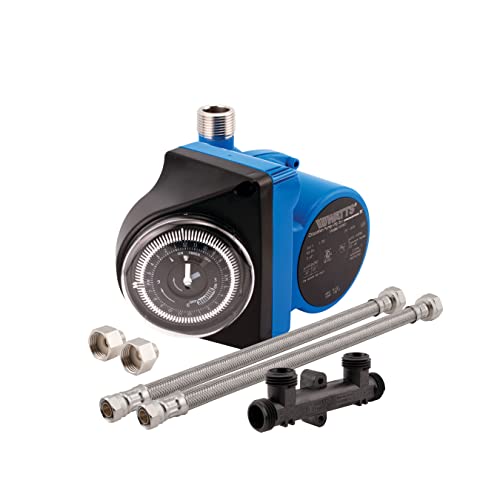
Watts Premier Recirculation System
$299.00A more affordable recirculation pump kit covering the same crossover valve retrofit path for a home without a dedicated return line.
Best for: A tank heater with a predictable schedule
Check price on Amazon
Aquanta WiFi Water Heater Controller
$189.00A smart controller that adds app-based scheduling and on-demand activation to an existing recirculation pump, worth it for a household wanting finer control than a built-in timer offers.
Best for: Measuring before spending on a new heater
Check price on Amazon
Intermatic WH21 Water Heater Timer
$69.26A standalone mechanical timer for a pump that lacks a built-in schedule, limiting circulation to the hours it is actually needed.
Best for: A 240 volt electric tank on a time of use rate
Check price on AmazonFrequently asked questions
- How does a hot water recirculation system actually work?
- A pump keeps water moving between the water heater and the fixture farthest from it, either through a dedicated return pipe or, on a retrofit, by using a crossover valve that connects the hot and cold lines at that fixture. Because the loop stays close to tank temperature, a tap delivers hot water almost immediately instead of after the cooled water already in the pipe clears out first.
- What is a crossover valve and how is it different from a dedicated return line?
- A crossover valve is a small valve installed under the sink at the farthest fixture, connecting the hot and cold lines so a pump can push hot water out and let it return through the existing cold pipe. A dedicated return line instead uses a genuinely separate pipe installed just for that return path, which is cleaner but usually only practical during construction or a full remodel.
- Does hot water recirculation waste energy?
- It trades one loss for another rather than eliminating loss entirely. Without recirculation, water that cools in the pipe between draws is simply run down the drain while waiting for hot water. With recirculation, that water stays hot in a continuously or periodically circulating loop instead, which loses heat to its surroundings the whole time it circulates. A timer and thermostat keep that second loss proportional to actual demand.
- Why do I need a timer on my recirculation pump?
- Without a timer, a recirculation pump can run around the clock, keeping the loop hot through overnight hours when nobody needs instant hot water at all. A timer restricts circulation to the hours the household actually wants it, typically mornings and evenings, which keeps the system's standing heat loss proportional to when the convenience is actually used.
- What is the cheapest way to improve an existing recirculation system?
- Insulating the loop pipe itself. Whether the system uses a dedicated return line or a crossover valve, the circulating pipe loses heat to its surroundings for every hour it runs, and pipe insulation reduces that loss directly without requiring any change to the pump or its controls.
- Should I install recirculation or a point-of-use heater for a distant bathroom?
- They solve the same complaint differently. Recirculation keeps the whole home's hot water line pre-heated at the cost of standing loss along the loop. A point-of-use heater installed at that single fixture avoids the wait without relying on the main tank at all, at the cost of adding a second heating unit. Compare them directly against your specific layout before choosing.
A timer and an aquastat are not optional extras on a recirculation pump; they are what keep the tradeoff defensible. A loop running continuously with neither control spends the most standing heat loss for the convenience it delivers.