Tankless vs Tank
Tankless vs Tank Water Heater
Researched from the DOE test procedures, NFPA 54 and NEC code tables, and manufacturer specifications. Updated .
Quick answer
A storage tank keeps a reservoir of hot water heated and ready, and the tap draws that reservoir down until the burner or the elements catch up. A tankless unit heats water only at the moment a tap opens, so there is no reservoir to run out of, but there is a firm maximum flow rate it cannot exceed at a given temperature rise. Neither format is universally better; each solves a different failure mode.
This page compares the two heads up on the factors that actually decide a real household's choice: hot water supply, floor space, the gas line, the vent, and what each one costs after the purchase. Installed cost estimating and labor rates are not this site's subject; houseprojectcalc.com covers what a given installation runs.
What's actually different in how a tank and a tankless heater deliver hot water?
A tank stores a fixed volume already heated to setpoint, so the first draws come out hot instantly and stay hot until the reservoir is drawn down faster than the burner or elements can refill it. A tankless unit has no reservoir at all; a flow sensor detects the draw and the burner or the heating element fires to bring that water up to temperature as it passes through, which is why a tankless unit's rated output is expressed as a maximum flow at a given temperature rise rather than as a first hour rating.
That difference is also why the two failure modes are opposite. A tank runs out when demand outlasts its stored volume. A tankless unit never runs out of stored water, but ask it to supply more flow than it is rated for and the outlet temperature simply drops, which shows up as a shower that goes lukewarm rather than cold.
Head to head: what changes when you switch formats?
The table below isolates the factors that decide most real households' choice, comparing a common 50 gallon tank against a condensing gas tankless unit.
| Factor | 50 gallon tank | Condensing gas tankless |
|---|---|---|
| Hot water supply | Runs out once the tank drains; refills at the burner or element recovery rate | No storage limit, but capped by a fixed maximum flow at a given temperature rise |
| Floor space | A closet-sized footprint for the tank itself | Wall-mounted; no floor footprint once installed |
| Gas line requirement | Usually matches whatever the existing tank already used | Often needs a larger gas line to feed the higher burner input |
| Venting | An existing atmospheric or power vent typically carries over on a like-for-like swap | A new dedicated vent sized to the unit is usually required |
| Standby loss | Constant, all day, whether or not water is drawn | None; the unit only fires when a tap opens |
Published standard Source: Manufacturer input ratings and published GPM-at-temperature-rise curves; NFPA 54 / IFGC gas pipe capacity tables. Gas line and vent requirements are specific to the model and the house; a licensed installer confirms both against the unit's rated input before the swap.
When is a tank genuinely the right call?
A tank is the right call for a household that is not currently running out of hot water. If the existing tank already gets everyone through the day, a tankless unit solves a problem that does not exist. A tank is also the simpler swap: the gas line and vent usually carry over unchanged, which keeps the project to a like-for-like replacement rather than a retrofit. Budget-conscious replacements, rentals, and houses where the water heater closet has no wall space for a tankless unit's required clearances all point toward a tank.
When does tankless actually win?
Tankless earns its keep in a household that is genuinely running out of hot water on a regular basis, especially one with three or more bathrooms in simultaneous morning use. It also wins on floor space in a tight mechanical closet, since a wall-mounted unit gives back the square footage a tank occupies. A household planning to stay in the house long enough to use up a serviceable unit's parts-and-service life, rather than a corroding tank's fixed lifespan, is another honest reason to choose tankless.
What does each one cost you later?
A tank pays standby loss every hour of every day it sits at setpoint, whether or not anyone draws water, and it has a fixed lifespan set by corrosion inside the steel shell; the anode rod life calculator and a sacrificial anode extend that life but do not make it indefinite. A tankless unit has no standby loss, but it needs an annual descaling to keep the heat exchanger clear of mineral scale, and a condensing unit adds a neutralizer that needs periodic attention; see the descaling interval calculator for how often that applies in hard water.
Is the fuel savings alone worth switching to tankless?
Told honestly: on fuel savings alone, the payback is slow, often slower than the tankless unit's own warranty period for a household that was not already running out of hot water. The payback calculator runs the actual numbers for a specific household's usage and local fuel price rather than a generic estimate. Tankless earns its cost back fastest through solving a real hot water shortage or reclaiming space that has its own value, not through the energy bill alone.
The gas line upsizing is often the largest single line in a tankless conversion quote. A tankless burner's input is frequently double or more what a tank used, and the existing gas line was sized for the smaller load; the gas line size calculator shows whether the existing line covers the new unit's demand. Installed cost estimating and labor pricing belong to houseprojectcalc.com.
The two anchors for this comparison
These four picks illustrate the comparison rather than exhausting it: one unit and one common accessory purchase on each side.
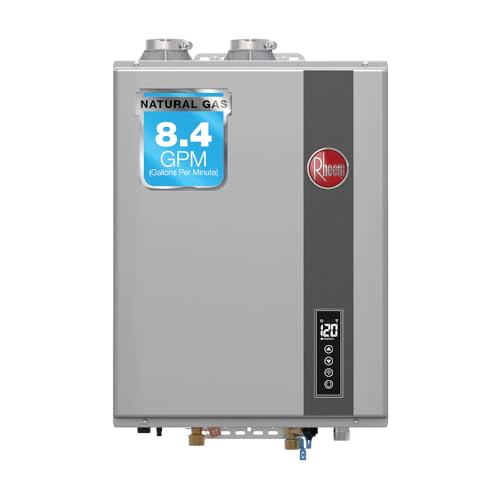
Rheem RTGH 8.4 GPM Natural Gas Indoor
$1,168.99A condensing indoor unit at 157,000 BTU input, the size most two to three bathroom houses land on once the inlet temperature is accounted for.
Best for: The common two to three bathroom whole house replacement
Check price on Amazon
Rheem RTG20320 Adjustable Concentric Vent Kit
$95.83A sealed-combustion concentric vent kit, the piece of a tankless retrofit most likely to be missing from a quote that only priced the unit.
Best for: A sealed combustion install through a wall
Check price on Amazon
Rheem PROE50 M2 50 Gallon
$945.99A straight 50 gallon electric replacement, the single most common residential tank size in the country and the least disruptive swap.
Best for: A straight 50 gallon electric replacement
Check price on Amazon
Eastman 2 Gallon Thermal Expansion Tank
$34.98A 2 gallon potable expansion tank sized for a 40 to 50 gallon tank on a closed plumbing system, worth checking for on any tank replacement.
Best for: The standard 40 or 50 gallon tank on a closed system
Check price on AmazonFrequently asked questions
- Does a tankless water heater really provide unlimited hot water?
- It provides unlimited duration, not unlimited flow. There is no reservoir to run out, so a shower will not go cold from running long. But every tankless unit has a maximum flow rate at a given temperature rise, so running a shower and a dishwasher and a washing machine at once can still exceed that ceiling and drop the outlet temperature.
- Why does switching from a tank to tankless often require a bigger gas line?
- A tankless unit heats all its water on demand, which takes a much higher burner input than a tank's recovery burner needs, sometimes double or more. The existing gas line was almost always sized for the smaller tank load, so it frequently cannot deliver enough gas volume to the larger tankless burner without being upsized.
- Is a tank water heater more likely to fail than a tankless unit?
- The failure modes differ rather than one being simply worse. A tank eventually corrodes through its steel shell and leaks, which is not repairable; a tankless unit's common failure is mineral scale buildup in the heat exchanger, which regular descaling prevents and a service technician can usually fix without replacing the whole unit.
- Does a tank water heater take up more space than a tankless unit?
- Yes. A typical 50 gallon tank needs a closet-sized floor footprint of roughly two feet square plus clearance, while a tankless unit mounts on a wall and uses no floor space at all once installed. That reclaimed floor space is one of the more concrete, non-fuel-savings reasons households choose tankless.
- How long does it actually take a tankless water heater to pay for itself over a tank?
- Longer than most buyers expect if fuel savings are the only factor counted, often outlasting the unit's own warranty period for a household whose tank was already adequate. The water heater payback calculator on this site runs the actual math against a specific household's usage and local fuel price rather than a generic industry claim.
- Can the existing vent be reused when replacing a tank with a tankless unit?
- Usually not. A tankless unit's burner input and combustion characteristics are different enough from a tank's that a new, dedicated vent sized to the specific model is typically required, even when the old tank vented through the same wall or chimney. A licensed installer confirms the vent requirement against the chosen unit's manual.
Leave the gas line and the vent to a licensed plumber or gas fitter. Backdrafting on an incorrectly vented gas appliance is invisible, and carbon monoxide from it is dangerous; the size of the gas line and the routing and material of the vent are not places to guess on either a tank or a tankless installation.