Anode Rods
Powered vs Sacrificial Anode Rod
Researched from the DOE test procedures, NFPA 54 and NEC code tables, and manufacturer specifications. Updated .
Quick answer
A sacrificial anode rod, whether magnesium or aluminum zinc, protects a tank by corroding itself away, which is why it is inspected and eventually replaced. A powered anode does the same electrochemical job through a small applied current instead of a consumable metal, which changes the whole cost and maintenance picture rather than just the material.
The choice between them is really a question of how long the tank is expected to stay in service and how much a recurring sulfur smell has already cost in frustration.
How does a powered anode actually differ from a sacrificial one?
Both protect the same steel through the same electrochemical principle. What changes is whether a metal rod is consumed to do it.
| Trait | Sacrificial rod | Powered rod |
|---|---|---|
| How it protects the tank | Corrodes itself instead of the tank steel | Applies a small current that suppresses corrosion without a consumable rod |
| Consumed over time | Yes, wears down and is replaced | No, nothing is consumed under normal operation |
| Typical replacement interval | About every 4 years (convention) | Not replaced under normal use; only the power module could eventually fail |
| Relative price position | Low cost per rod | Several times the cost of a sacrificial rod |
| Power requirement | None | Needs a nearby standard outlet |
| Universal fitment | Fits nearly any tank with a standard anode port | Not universal, Bradford White tanks need a specific hot-outlet variant |
| Effect on rotten egg smell | Magnesium can worsen it, aluminum zinc partially suppresses it | Eliminates the sulfate reducing bacteria mechanism outright in most cases |
Convention Source: Manufacturer specifications for Corro-Protec, Chromex and briidea powered anodes; common plumbing trade replacement interval for sacrificial rods.. Fitment for powered anodes depends on the specific tank brand and anode port. Confirm compatibility before buying, especially on Bradford White tanks.
When is a sacrificial anode rod the right choice?
A sacrificial rod is the right call on a tank without a chronic smell problem, on a tank nearing the end of its expected life anyway, or when there is no outlet near the top of the tank and adding one is not worth it for a single anode. It is also the simpler choice for anyone comfortable doing a routine four year swap rather than paying more upfront to avoid it.
It is the weaker choice for a tank on hard or aggressive water where rods are being consumed faster than the planning interval, since the recurring inspection and replacement work adds up on that kind of water. It is also the weaker choice where a rotten egg smell has already returned after switching materials, since a sacrificial rod of either kind still leaves some bacteria reaction possible.
When is a powered anode rod the right choice?
A powered anode is the right call for a tank the owner intends to keep for its full service life, since the module is fitted once rather than replaced on a schedule. It is also the right call for a chronic rotten egg smell that persisted even after switching to an aluminum zinc sacrificial rod, since impressed current removes the mechanism that produces the smell rather than only suppressing it.
It is the wrong call for a tank near replacement age, since the upfront cost buys years of no-maintenance protection that will not be used. It also is not automatically compatible with every tank: Bradford White tanks specifically require the variant built for their hot outlet design, and fitment should be confirmed against the tank's anode port before buying any powered unit.
What does each option cost you later?
A sacrificial rod's later cost is the recurring task itself: draining pressure, removing the old rod, and fitting a new one, roughly every four years or sooner on hard water. It is a small, predictable, repeating job for the life of the tank.
A powered anode's later cost is mostly the risk that the power module or its cable eventually fails, which is a rare event covered by warranty terms that vary by product, the Chromex Powered Titanium Anode for example is sold with a stated 30 year warranty on its module. Once fitted, there is effectively nothing to schedule, which is the entire premise of paying more for it upfront.
Powered options, and a sacrificial baseline
Three powered anodes at different price points, plus a sacrificial magnesium rod for comparison on a tank where a one-time fix is not the priority.

briidea Powered Anode Rod, 40 to 89 Gallon
$79.99The lowest cost way to try impressed current before committing to a pricier module, fits a 40 to 89 gallon tank.
Best for: Trying impressed current cheaply
Check price on Amazon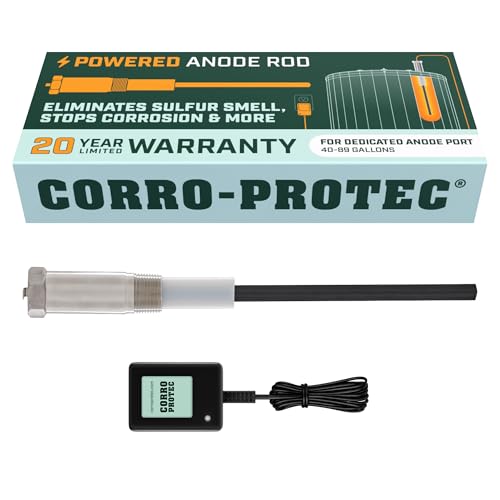
Corro-Protec Powered Anode Rod
$179.95The most established powered anode in the category, with a Bradford White specific variant also sold for tanks that need it.
Best for: Hard water, or a tank you intend to keep
Check price on Amazon
Chromex Powered Titanium Anode, 40 to 89 Gallon
$129.99A titanium powered anode for 40 to 89 gallon tanks sold with a stated 30 year warranty on the module.
Best for: A 40 to 80 gallon tank
Check price on Amazon
44 in Flexible Magnesium Anode Rod
$29.99A straightforward magnesium rod for anyone who decides a scheduled swap beats an upfront module cost.
Best for: A routine replacement on soft or neutral water
Check price on AmazonFrequently asked questions
- Does a powered anode rod ever need to be replaced?
- Under normal operation, no metal is consumed, so there is nothing to replace on the schedule a sacrificial rod needs. The only failure point is the power module or its cable, which is a rare event and is typically covered by a manufacturer warranty, the Chromex Powered Titanium Anode for example carries a stated 30 year warranty on that module.
- Will a powered anode rod fit a Bradford White water heater?
- A standard powered anode is not guaranteed to fit a Bradford White tank, because Bradford White uses a hot outlet design rather than a separate anode port on many models. Corro-Protec sells a specific Powered Anode for Bradford White variant built for that hot outlet, and fitment should be confirmed against the exact tank model before buying any powered anode for a Bradford White unit.
- Is a powered anode rod worth the extra cost over a sacrificial one?
- It depends on how long the tank will be kept and whether a smell has been a recurring problem. On a tank expected to run for many more years, or one where an aluminum zinc rod did not fully stop a rotten egg smell, a powered anode's higher upfront cost buys years without a scheduled swap. On a tank nearing replacement, a sacrificial rod is the more sensible spend.
- Do I need an electrician to install a powered anode rod?
- Most powered anodes plug into a standard household outlet near the top of the tank, so an electrician is not required if a suitable outlet already exists nearby. If no outlet is within reach of the cord, adding one is an electrical job, and that installation decision, along with its cost, is separate from the anode itself and belongs with a licensed electrician.
- Can a powered anode rod eliminate a rotten egg smell completely?
- In most cases yes, because impressed current does not rely on a consumable metal reacting with sulfate reducing bacteria the way magnesium does, which removes the mechanism that produces the smell rather than only slowing it. Results still depend on the specific water chemistry, and a smell that persists after a properly fitted powered anode points to a water quality issue rather than the anode itself.
- How much more does a powered anode cost than a sacrificial rod?
- A powered anode typically runs several times the price of a single sacrificial rod, though the exact gap varies by product and changes over time, so check current pricing on the specific items rather than assuming a fixed multiple. The comparison that matters is total cost over the tank's remaining life: one powered module against several scheduled sacrificial replacements.
A powered anode's transformer plugs into a standard outlet near a source of hot water and pressure. Use a properly grounded, GFCI-protected outlet for that connection, keep the cord and module away from any dripping or spray, and follow the specific manufacturer instructions for the model bought, since mounting and cable routing differ between products. See the full Corro-Protec Powered Anode review for one product's specifics.