Accessories
Best Water Heater Anode Rods
Researched from the DOE test procedures, NFPA 54 and NEC code tables, and manufacturer specifications. Updated .
Quick answer
An anode rod is a sacrificial length of reactive metal, typically hung from a fitting on top of the tank down through the water, whose entire job is to corrode before the steel tank wall does. Electrochemically, the anode metal is more reactive than the tank steel, so stray corrosion current in the water attacks the rod first. Once a rod is fully consumed, that protection stops and the tank's own steel starts corroding at the seams and welds instead, which is the leading cause of an otherwise well-maintained tank failing years earlier than its rated life.
The picks below cover the three anode types this niche actually needs: magnesium, the standard first-choice material; aluminum zinc, for water conditions where magnesium reacts poorly; and powered anodes, which trade an upfront cost for never being consumed. Water chemistry and physical clearance both change which type is right for a given tank, and both get their own section below.
What does an anode rod actually do, and why does it matter?
Steel corrodes when it loses electrons to its surroundings. An anode rod is made from a metal more willing to give up electrons than the tank steel, so it corrodes preferentially and sacrifices itself instead of the tank. This is the same principle behind a zinc sacrificial anode on a boat hull. Once the rod is used up, roughly to a thin core wire with most of its original diameter gone, the tank steel becomes the next most reactive metal in the water and starts corroding at its weakest points, usually the bottom seam and any threaded fittings.
A tank with a fully consumed anode and no replacement can still function normally for a while, which is exactly what makes an ignored anode dangerous: there is no symptom until a pinhole leak develops, often years earlier than the tank's rated life would suggest.
Which anode rod material should I choose: magnesium, aluminum zinc, or powered?
Magnesium is the standard factory-installed material and the correct default on unsoftened municipal or well water with no known odor issue. It is the most reactive of the common anode metals, which is generally an advantage, but that same reactivity is what makes it consumed fastest under two specific conditions covered below.
Aluminum zinc reacts more slowly than magnesium and holds up better on softened water. It is also the material of choice when a sulfur or rotten egg smell has appeared in hot water, discussed in its own section below, since the zinc component suppresses the bacterial reaction responsible for that odor in a way magnesium does not.
Powered anodes use an externally powered titanium electrode rather than a sacrificial metal, protecting the tank through impressed current instead of consumption. They are never used up and never need replacement, at the cost of a higher purchase price and a small continuous electrical draw from a plug-in transformer.
Why does softened water shorten a magnesium anode's life so much?
Water softeners work by exchanging calcium and magnesium ions in the incoming water for sodium ions, which raises the water's conductivity. Higher conductivity accelerates the electrochemical reaction that consumes a sacrificial anode, and magnesium, already the most reactive common anode material, is consumed dramatically faster under those conditions. On fully softened water, a magnesium rod that would otherwise last four to five years is commonly consumed in about two years instead, sometimes less.
On a softened-water system, aluminum zinc is the more practical sacrificial choice, or a powered anode removes the consumption problem entirely since it does not rely on being used up. Whether to install or maintain a softener at all is a water treatment decision that belongs to homewatercalc.com; how that softener changes anode life on the water heater side is ours.
What causes a rotten egg smell in hot water, and which anode fixes it?
A sulfur or rotten egg odor limited to hot water, and absent from cold water at the same taps, is almost always caused by sulfate-reducing bacteria in the tank reacting with hydrogen released from a magnesium anode to produce hydrogen sulfide gas. The bacteria are naturally present in many water supplies and are harmless to health, but the smell they produce with a magnesium anode present is unmistakable and unpleasant.
The practical fix is switching the sacrificial rod from magnesium to aluminum zinc, which does not produce hydrogen in the same reactive way and generally resolves the odor within days to a couple of weeks after replacement, or switching to a powered anode, which eliminates the sacrificial reaction entirely. Chlorinating the tank is a separate, more involved fix some plumbers use, but changing anode type is the first thing to try since it is a same-day job.
What clearance do I need above the tank to replace an anode rod?
A standard rigid anode rod is commonly 44 inches long and needs roughly that much clear vertical space above the tank's hex-head fitting to be pulled straight up and out, which many basements, closets, and low-ceiling utility rooms simply do not have. Two alternatives solve this without a wall or ceiling cut: a flexible rod, which bends as it is fed in and can be worked into a space with a fraction of the standard clearance, and a segmented rod, made of short links joined by a cable, which folds on itself during removal and installation. Check available overhead clearance before ordering a rigid rod; measuring it wrong is the most common reason a straightforward anode swap turns into a bigger job.
How does anode life compare across type and water condition?
| Anode material | Unsoftened water | Softened water | Replacement needed? |
|---|---|---|---|
| Magnesium | 4 to 5 years | About 2 years | Yes, sacrificial |
| Aluminum zinc | 5 to 6 years | 3 to 4 years | Yes, sacrificial |
| Powered (titanium) | Not consumed | Not consumed | No, impressed current |
Convention Source: Compiled from manufacturer published anode life estimates and the consensus of verified owner reviews reporting replacement intervals under known water conditions.. Actual life varies with water chemistry, tank temperature setting, and usage volume. Use the anode rod life calculator for a household-specific estimate rather than these ranges alone.
How we chose
We did not remove or inspect these anode rods from a tank ourselves. These picks are compiled from manufacturer published material composition, length, and diameter specifications, and the consensus of verified owner reviews describing fit, odor resolution, and observed service life under stated water conditions.
Buying tips
Check the hex-head size on your existing rod or tank fitting, commonly 1 1/16 inch, before ordering a replacement. If you are replacing a rod for the first time on an older tank, expect the factory rod to be seized; a breaker bar and an impact wrench make a meaningful difference over hand tools alone, and turning off power to an electric tank's upper element circuit before working near the top fitting is good practice regardless.
The Expert-tier powered anodes cost several times what a sacrificial rod does. They make the most sense for a tank in a hard-to-access location where replacement labor would be repeated cost, or for someone who has already replaced two or three sacrificial rods and wants to stop. They are not necessary for a tank on easy, unsoftened water where a standard magnesium rod already lasts four or five years without issue.
The picks, by tier
Use the anode rod life calculator to estimate remaining service life from water hardness and softener use before deciding whether to replace like for like or switch type.

44 in Flexible Magnesium Anode Rod
$29.99A standard 44 inch magnesium rod at the lowest cost, the correct default replacement for a tank on unsoftened municipal or well water with no rotten egg odor history.
Best for: A routine replacement on soft or neutral water
Check price on Amazon
44 in Flexible Aluminum Zinc Anode Rod
$31.99A budget aluminum zinc rod for a tank on softened water or with a known odor issue, where magnesium is the wrong material regardless of price.
Best for: A smell problem on a budget
Check price on Amazon
briidea Powered Anode Rod, 40 to 89 Gallon
$79.99An entry-level powered anode for a buyer who wants to stop replacing rods entirely without paying for the premium titanium options.
Best for: Trying impressed current cheaply
Check price on Amazon
Eastman 42 in Flexible Magnesium Anode
$35.25A well-reviewed 42 inch magnesium rod, the buy-once pick for a standard tank on hard or moderately hard unsoftened water.
Best for: A tank with a low ceiling above it
Check price on Amazon
Ozek 44 in Segmented Magnesium Anode
$39.45A comparable 44 inch magnesium rod to the Eastman, worth comparing on fit for a specific tank's fitting depth.
Best for: The tightest installations
Check price on Amazon
Ozek 44 in Segmented Aluminum Zinc Anode
$36.45A mid-tier aluminum zinc rod for a tank on softened water where magnesium would be consumed unusually fast.
Best for: A tank with a sulphur smell
Check price on Amazon
Aluminum Zinc Anode Rod with Stainless Nipple
$39.95A flexible-format aluminum zinc rod, combining odor and softened-water resistance with the ability to bend around obstacles during installation.
Best for: A rod that has not been touched in a decade
Check price on Amazon
Chromex Powered Titanium Anode, 40 to 89 Gallon
$129.99A mid-priced powered anode with a titanium electrode, a durable middle ground between a basic powered unit and the premium Corro-Protec line.
Best for: A 40 to 80 gallon tank
Check price on Amazon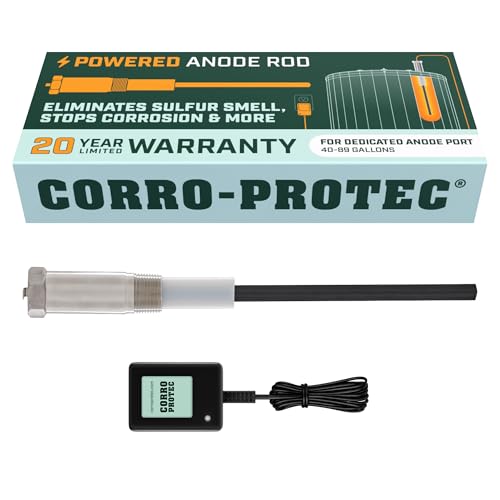
Corro-Protec Powered Anode Rod
$179.95A premium powered anode that protects the tank for as long as the unit runs, with no sacrificial material to replace, ever.
Best for: Hard water, or a tank you intend to keep
Check price on Amazon
Corro-Protec Powered Anode, Bradford White
$199.95A version of the same powered anode fitted specifically for Bradford White tank hex-head connections.
Best for: A Bradford White tank
Check price on AmazonFrequently asked questions
- How often should a water heater anode rod be replaced?
- On unsoftened water, a magnesium anode rod typically lasts 4 to 5 years before needing replacement. On softened water, that drops to about 2 years because higher water conductivity accelerates the sacrificial reaction. Checking the rod annually after year 2 or 3 catches a consumed rod before the tank steel itself starts corroding.
- Why does my hot water smell like rotten eggs?
- A sulfur smell limited to hot water is usually caused by sulfate-reducing bacteria reacting with hydrogen released from a magnesium anode rod, producing hydrogen sulfide gas. Switching the sacrificial rod to an aluminum zinc anode, or to a powered anode, typically resolves the odor within days to a couple of weeks.
- Does a water softener shorten anode rod life?
- Yes, significantly for magnesium rods. Softened water has higher conductivity from the sodium ion exchange, which accelerates the electrochemical reaction that consumes a sacrificial anode. A magnesium rod that lasts 4 to 5 years on unsoftened water is commonly consumed in about 2 years on fully softened water.
- What is a powered anode rod and is it worth the cost?
- A powered anode uses an externally powered titanium electrode to protect the tank through impressed current rather than sacrificial consumption, so it never needs replacement. It costs several times more than a sacrificial rod upfront, which pays off over multiple replacement cycles, especially on softened water or in a tank with difficult access.
- Can I replace an anode rod if my ceiling is too low for a straight rod?
- Yes. A flexible anode rod bends as it is installed and needs only a fraction of the vertical clearance a rigid 44 inch rod requires. A segmented rod, made of short links on a cable, folds during removal for the same reason. Both exist specifically for low-clearance basements, closets, and utility rooms.
- What happens if I never replace a consumed anode rod?
- Once an anode rod is fully consumed, it stops protecting the tank and the steel tank wall becomes the next most reactive metal in the water, so it begins corroding, typically starting at the bottom seam and threaded fittings. This is a leading cause of a tank failing years before its rated life, often with no warning symptom before a leak appears.
Match the rod to your water condition, not just the fitting. Softened water or a sulfur smell both mean magnesium is the wrong default, and an unreplaced rod means the tank itself is next in line.