Tankless
Condensing vs Non-Condensing Tankless Water Heater
Researched from the DOE test procedures, NFPA 54 and NEC code tables, and manufacturer specifications. Updated .
Quick answer
Condensing and non-condensing describe how much heat a tankless unit pulls out of its own exhaust before venting it outside. A non-condensing unit lets the exhaust exit while it is still hot. A condensing unit runs the exhaust through a second heat exchanger first, cooling it enough that water vapor condenses out, and recovers that extra heat into the water being heated. The two designs differ most in practice at the vent, not at the burner.
Installed cost estimating and labor pricing for the venting work are not this site's subject; houseprojectcalc.com covers what an installation runs. This page compares what the two designs actually require and what each costs to live with afterward.
What actually makes a tankless unit condensing?
A condensing tankless water heater runs its exhaust through a secondary heat exchanger before venting it, extracting additional heat and cooling the exhaust below the point where water vapor in it condenses into liquid. That condensate is mildly acidic and has to drain somewhere, either to a neutralizer and then a drain, or to an approved disposal point. A non-condensing unit skips that step entirely; its exhaust exits at a much higher temperature, with nothing to drain but also less heat recovered from the fuel burned.
What changes at the vent, condensing vs non-condensing
| Factor | Non-condensing | Condensing |
|---|---|---|
| Vent material | Stainless steel or another high-temperature listed material | Schedule 40 PVC or CPVC, since exhaust is already cooled below its dew point |
| Exhaust temperature | Stays hot, close to the flue gas temperature | Cooled by the secondary heat exchanger before it exits |
| Condensate produced | None | Acidic condensate that must drain to a neutralizer or an approved disposal point |
| Typical efficiency class | Lower; more heat leaves with the exhaust | Higher; the secondary heat exchanger recovers more of the fuel input |
Published standard Source: Manufacturer venting instructions and the International Fuel Gas Code (IFGC) venting tables. Always vent to the exact material and length the manufacturer's installation manual lists for that model; substituting vent material voids the listing.
When is non-condensing genuinely the right call?
Non-condensing makes sense on a retrofit with a short existing stainless vent run already in place from a prior installation, where reusing it avoids running new PVC entirely. It also suits a warm climate replacement of a like unit, where the modest efficiency gap against a condensing model matters less than a straightforward swap. A household that does not want to manage a condensate line at all, even a small one, has a reasonable case for non-condensing.
When does condensing win?
Condensing wins clearly on a new install or a long vent run, since PVC is dramatically simpler and less expensive to route than stainless steel over distance, and that vent material gap is usually where most of the installed cost difference between the two designs actually sits. It also wins for anyone prioritizing the higher published efficiency class, provided the household is willing to add a neutralizer and manage where the condensate drains.
What does each one cost you later?
A condensing unit's neutralizer media needs periodic replacement to keep the acidic condensate from damaging cast iron drain lines or a septic system, and its condensate line can freeze if it is ever routed through unconditioned space. A non-condensing unit has no condensate to manage, but if its vent is ever rerouted or extended, the household is buying stainless steel again rather than PVC, and its lower efficiency class means more fuel burned over the unit's operating life.
Does the vent choice affect anything beyond cost?
Yes. Vent material and routing are a listed, code-governed part of a gas appliance installation, not a place for a close substitute or a shortcut. An incorrectly vented tankless unit, condensing or not, can backdraft combustion products into the house, and that failure is invisible without a detector.
Have a licensed installer size and route the vent to the exact specification in the unit's manual, and install a carbon monoxide detector nearby. This applies equally to condensing and non-condensing units.
A condensing and a non-condensing pick, each with its typical accessory
Four picks: one unit and one accessory purchase most owners of that unit end up making.
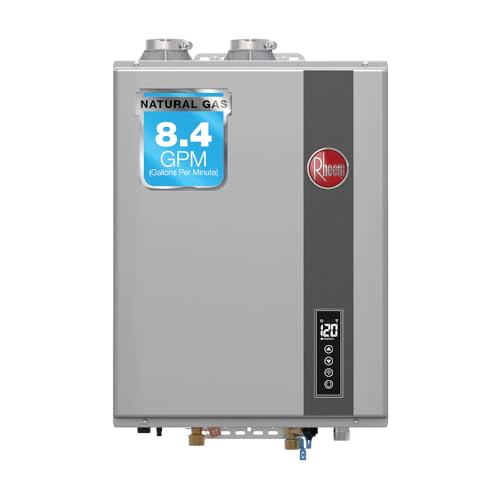
Rheem RTGH 8.4 GPM Natural Gas Indoor
$1,168.99A condensing indoor unit at 157,000 BTU that vents in PVC, the size most two to three bathroom houses land on.
Best for: The common two to three bathroom whole house replacement
Check price on Amazon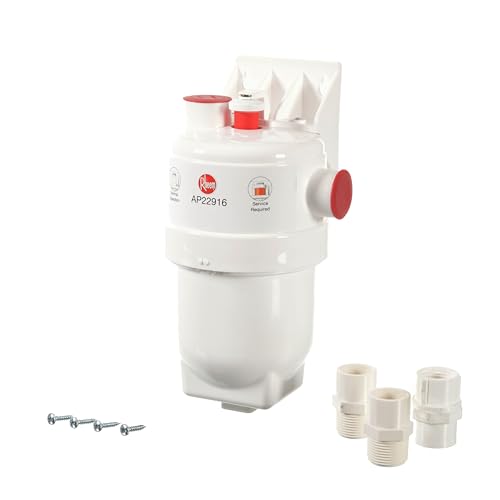
Rheem Axiom External Neutralizer RTG20329AR
$149.85The manufacturer-listed neutralizer for a Rheem condensing tankless, the part an inspector wants to see rather than a generic substitute.
Best for: A Rheem condensing tankless that must pass inspection
Check price on Amazon
Rheem RTG 7.0 GPM Natural Gas Indoor
$653.77A 160,000 BTU non-condensing indoor unit, the cheapest way into a real brand-name gas tankless with a dealer parts channel behind it.
Best for: A one or two bathroom house in a warm inlet climate
Check price on Amazon
Rheem RTG20282 3 x 5 in Vertical Vent Kit
$119.83The manufacturer vent kit matched to the unit's routing; on a gas appliance this is not a category where a close substitute is appropriate.
Best for: A Rheem tankless vented vertically
Check price on AmazonFrequently asked questions
- Is a condensing tankless water heater always the better choice?
- Not always. It publishes a higher efficiency class and usually costs less to vent over a long run because it uses PVC instead of stainless steel, but it adds a condensate line and a neutralizer to manage. A short retrofit reusing an existing stainless vent can make a non-condensing unit the simpler and cheaper choice despite its lower efficiency number.
- Can a condensing tankless unit vent in PVC over any distance?
- The maximum vent length in PVC is set by the specific manufacturer's installation manual and code tables, not a fixed number across all condensing units. Longer runs sometimes require a larger vent diameter to stay within the listed limit, so the exact model's manual has to be checked before assuming a given run length works.
- What is condensate neutralizer for, and is it required?
- Condensate from a condensing tankless unit is mildly acidic, and a neutralizer, typically a cartridge of calcite media, raises its pH before it reaches a drain. Many plumbing codes and some manufacturer warranties require one before condensate can be discharged into a drain system, particularly cast iron piping or a septic system.
- Why is stainless steel required for a non-condensing tankless vent?
- A non-condensing unit's exhaust exits at a much higher temperature than a condensing unit's cooled exhaust, and ordinary PVC is not rated for that heat. Stainless steel or another manufacturer-listed high-temperature material is required to safely contain and vent that hotter exhaust without degrading.
- Does a condensing tankless unit need more maintenance than a non-condensing one?
- It adds one task a non-condensing unit does not have: periodic neutralizer media replacement, typically checked during the annual descaling service. Both designs need the same annual descaling for mineral scale regardless of whether they condense, so the added maintenance burden is small rather than a separate full service.
- Can a condensate line freeze in an unconditioned space?
- Yes, and a frozen condensate line can back up and shut the unit down or cause water damage. Routing the condensate line through a conditioned space, or insulating and, where climate requires it, heat-tracing a line that must pass through an unconditioned area, prevents that failure.
Vent sizing and routing on a gas tankless unit, condensing or not, belongs to a licensed plumber or gas fitter. Substituting vent material or shortening the required clearances to save cost risks a backdraft, and carbon monoxide from it is invisible without a detector.