Tankless
Best Tankless Water Heaters
Researched from the DOE test procedures, NFPA 54 and NEC code tables, and manufacturer specifications. Updated .
Quick answer
Tankless water heaters trade a 40 or 50 gallon tank sitting idle all day for a unit that heats water only when a fixture calls for it. That trade pays off in standby losses eliminated and in a compact footprint, but it introduces two decisions a tank never asked you to make: which fuel, and how much simultaneous flow you actually need.
Gas is the dominant choice for whole-house tankless in the United States, and it carries a real hidden cost that a lot of buying guides skip: the gas line itself. Electric tankless is not a lesser version of gas, it is a different decision entirely, one about your electrical service rather than about the heater. This page covers both, weighted toward gas because that is where most whole-house tankless purchases land, with the electric side scoped honestly.
Start with the tankless sizing calculator to get a target flow rate for your climate and fixture count before you shop by model number.
Is gas or electric tankless right for your house?
This is not really a heater question, it is an infrastructure question. A whole-house gas tankless unit needs a gas line sized for its full input, usually 3/4 inch or larger run from the meter, plus dedicated venting. A whole-house electric tankless unit needs a 240 volt circuit that can run into the 80 to 120 amp range on the largest models, which is more than most panels have spare.
The practical result: gas is the more common whole-house choice in most of the country because the gas line, once sized, delivers far more energy than a typical panel can spare in amps. Electric tankless shines in two situations instead: a single point-of-use fixture where running a small dedicated gas line makes no sense, or a warm climate where the incoming water is already close to the target temperature, so the temperature rise and the amperage it demands both stay low. Check your panel headroom with the breaker size calculator before shopping electric models by GPM alone.
What does "GPM" on the listing actually promise?
Every tankless listing advertises a flow rate in gallons per minute, and almost none of those listing titles state the temperature rise that figure assumes. A flow rate without a rise is an incomplete number: the same unit might deliver 8 gallons per minute of gently warmed water in Florida and 4 gallons per minute of properly heated water in Minnesota. The manufacturer publishes a full flow-versus-rise curve in the spec sheet and owner manual, and that curve, not the headline number on the box, is what tells you whether a unit covers your house. Run your own numbers on the temperature rise calculator before trusting a single advertised GPM figure.
How we chose these picks
These picks were compiled from manufacturer published specifications, installation manuals and the consensus of verified owner reviews. We did not install, test or run any of these units ourselves, and we are not claiming to. Where a manufacturer does not publish a figure, such as flow at a specific rise, this page says so rather than estimating one.
Buying tips before you order a tankless unit
- Size to your worst simultaneous draw (two showers plus a dishwasher, for example), not to your average draw. The peak hour demand calculator helps set that number.
- Confirm your incoming gas line and meter capacity before ordering a gas unit. An undersized line starves every appliance on it, not just the water heater.
- Budget for a service valve kit and, on a condensing unit, a condensate drain path. These are rarely bundled with the heater.
- If your project also needs a cost estimate for professional installation, that is not something we cover here; houseprojectcalc.com handles installation cost estimating.
Gas line and venting work is a licensed plumber or gas fitter's job. Improper venting can backdraft carbon monoxide into a home invisibly. Sizing and buying the right unit is yours to do; connecting the gas and flue is not a DIY task.
The picks, by tier
Gas units dominate the whole-house tier because a single 3/4 inch gas line can move far more energy than a typical 240 volt circuit. Electric units earn their place at point-of-use scale or in warm climates where the temperature rise is small enough that amperage stays manageable.

Rheem RTG 7.0 GPM Natural Gas Indoor
$653.77A compact indoor natural gas unit sized for a single bathroom or a small condo, at the low end of the whole-house gas lineup.
Best for: A one or two bathroom house in a warm inlet climate
Check price on Amazon
Rheem RTEX-13 13kW
$278.00An electric point-of-use unit for a single shower or a remote sink, no gas line and no venting to plan around.
Best for: A single bathroom in a warm inlet climate
Check price on Amazon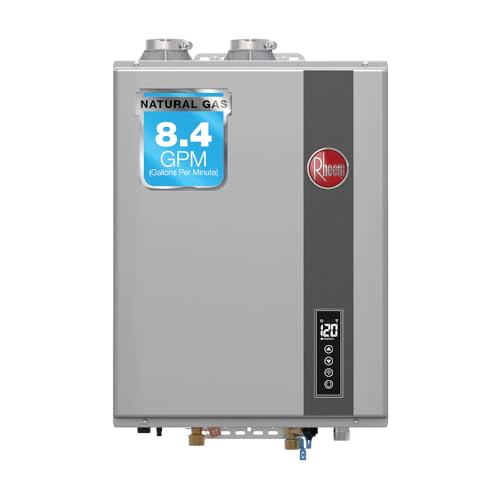
Rheem RTGH 8.4 GPM Natural Gas Indoor
$1,168.99The buy-once whole-house gas pick: enough published flow for two to three fixtures without the cost step to the largest condensing models.
Best for: The common two to three bathroom whole house replacement
Check price on Amazon
Rinnai RX130iN Condensing
$1,264.20A recirculation-ready condensing gas unit for a house that also wants faster hot water at distant fixtures.
Best for: Households that run short, repeated draws
Check price on Amazon
Stiebel Eltron Tempra 24 Trend 24kW
$521.69The largest electric tankless most homes can actually run, but only where a 240 volt service already has the breaker capacity to spare.
Best for: Cooler inlet climates with service capacity
Check price on Amazon
Rheem RTGH 9.0 GPM Natural Gas Indoor
$1,219.99The top of the gas lineup for a large house with high simultaneous demand, at a real step up in installed cost.
Best for: Cold groundwater regions where the rise eats the flow
Check price on Amazon
Rinnai RX160iN Condensing
$1,442.70The highest published flow in this lineup, aimed at big houses or short-term rentals running multiple bathrooms at once.
Best for: Three bathroom houses in a cold inlet region
Check price on Amazon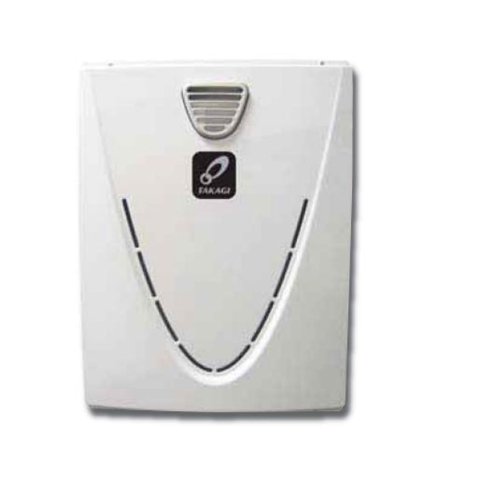
Takagi T-H3S-OS-N Condensing Outdoor
$1,355.95An outdoor condensing gas unit for a house that wants to skip interior venting entirely at the largest gas capacity here.
Best for: Warm climates that still want a high efficiency unit
Check price on AmazonFrequently asked questions
- Is a gas or electric tankless water heater better for a whole house?
- Gas is the more common whole-house choice because a properly sized gas line delivers far more energy than most home electrical panels can spare in amps. Electric tankless works well for a single point-of-use fixture or a warm climate with a small temperature rise, but a whole-house electric unit like the Stiebel Eltron Tempra 24 needs a large dedicated 240 volt circuit most panels do not have room for.
- What does the GPM number on a tankless listing actually mean?
- It is the maximum flow rate the unit can heat, but listing titles almost never state the temperature rise that figure assumes. The same unit delivers far less flow at a large rise, such as heating 37 F winter groundwater to 120 F, than at a small one. The manufacturer publishes a full flow-versus-rise curve; that curve, not the headline GPM, tells you what the unit covers in your climate.
- Do tankless water heaters need a bigger gas line than a tank?
- Often yes. A tankless unit fires at a much higher instantaneous input than a standard 40,000 BTU tank water heater, so the gas line feeding it frequently needs upsizing, sometimes all the way back to the meter. This is the hidden cost buyers most often miss when comparing a tankless unit's price to a tank's price.
- Can I replace a gas tank water heater with an electric tankless unit?
- Only if your electrical panel has spare capacity for a large 240 volt circuit, often 80 to 120 amps on a whole-house electric tankless model. Most panels replacing a gas water heater do not have that headroom without an electrical service upgrade, which is why gas-to-gas tankless swaps are far more common than gas-to-electric-tankless swaps.
- How much simultaneous hot water use should I size a tankless unit for?
- Size for your worst realistic simultaneous draw, such as two showers running with a dishwasher going, not your average daily use. A household needing roughly 6 to 8 gallons per minute at a winter temperature rise typically needs a larger whole-house unit like the Rheem RTGH-90 or Rinnai RX160iN rather than an entry-level model.
- Does a tankless water heater run out of hot water like a tank does?
- No, a properly sized tankless unit heats water on demand and does not run out the way a tank empties its stored volume. It can, however, be outrun by demand that exceeds its maximum flow rate at the current temperature rise, which shows up as reduced pressure or lukewarm water at multiple fixtures rather than a hard cutoff.
A tankless unit is only as good as the gas line or circuit feeding it. Confirm your infrastructure before you fall in love with a GPM number on a box; that number was measured at a rise your winter groundwater may not match.