Converting to tankless · Intermediate
Condensing Gas Tankless Conversion
Quick answer
A condensing tankless vents in PVC rather than stainless, which is usually where the installed cost difference against a non-condensing unit actually goes. It also produces acidic condensate, so it needs a drain and, in many jurisdictions, a neutralizer before that condensate reaches the sewer.
This is where most two to three bathroom houses land once someone takes the temperature rise seriously. A condensing unit extracts more heat from the exhaust, which both raises efficiency and drops the flue temperature far enough to vent in plastic.
The tradeoff is condensate. A condensing appliance produces acidic water, which needs a drain and often a neutralizer. That is a real requirement rather than an accessory, and it is on this list for that reason.
The complete parts list
Every line below is a real listing with a live link. Prices come from verified catalog data and change often.
The unit
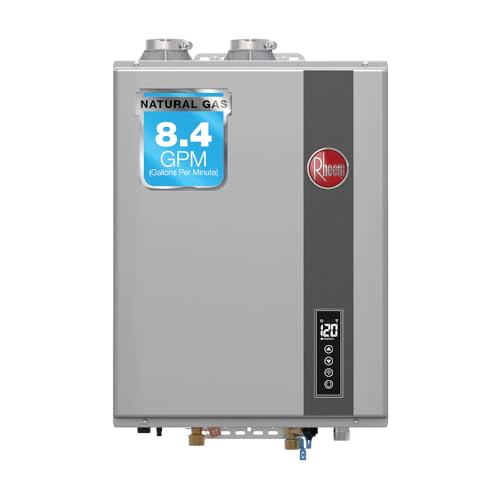
$1168.99157,000 BTU condensing indoor. Size on input rather than headline flow, because input is what holds flow up when the inlet is cold.
-
 Rheem
RheemRheem RTGH 8.4 GPM Natural Gas Indoor
The condensing unit most two to three bathroom whole house replacements settle on.
Service and gas
$118.44-
 HYDRO MASTER
Hydro Master 3/4 in IPS Service Valve Kit
Service valves with the pressure relief valve, which is the full set a tankless install needs at the unit.
-

-

Venting and condensate
$197.41The condensate side is what separates a condensing install from a non-condensing one.
-

-
 American Valve
American Valve CondensateRx Neutralizer
Neutralizes the acidic condensate before it reaches the drain, which many jurisdictions require.
-
 Xinhw
XinhwCondensate Neutralizer Refill Media, Calcite
The media is consumed, not permanent. An exhausted neutralizer passes acid straight through.
Keeping the heat exchanger clean
$239.44-
 Chromex
Chromex Flush Kit with NSF Descaler
Pump, hoses, bucket and NSF certified descaling solution in one box, so nothing is missing on the day.
- HYDRO MASTER
Hydro Master 3/4 in IPS Service Valve Kit
-
 Waterdrop
Waterdrop AP431 Scale Inhibitor
A polyphosphate inhibitor upstream keeps hardness in suspension. It slows scaling, it does not replace flushing.
Comfort and containment
$154.09-
 Rheem
RheemRheem RRTG20006DW Digital Remote
A wired remote, which is how the setpoint gets changed without going out to the unit.
-
 Camco
CamcoCamco 11430 Aluminum Tankless Pan
An aluminium pan for a unit with a condensate drain as well as water connections.
-
 Dojomadf
Self-Adhesive Foil Pipe Insulation, 3/4 in
Pre-slit self adhesive pipe insulation on the hot outlet.
Parts list total
$1878.3713 lines across 5 groups. Prices change often and are a guide only. This is the parts list, not the installation: gas, flue and electrical work belong to the licensed trade that signs the permit.
Parts list
Get this parts list as a checklist
One email with the full list, every item linked, so you can tick it off at the supplier or on your phone.
No spam. Unsubscribe whenever you like.
What you can skip
Telling you not to buy something is what makes the rest of the list credible.
- A scale filter, in soft water. Below about 7 grains per gallon the annual flush handles it and the cartridge is a running cost for nothing.
- A WiFi module. Useful for fault alerts, not for performance. It belongs on the expert list.
What to upgrade first
- The neutralizer, if the condensate goes to a septic system or a metal drain. Acidic condensate attacks both.
- Scale protection, above 10 grains per gallon. At that hardness the flush interval drops to nine months and the inhibitor buys some of that back.
The other tiers in this ladder
- Entry Gas Tankless Conversion (Beginner): The parts list for a first gas tankless installation, with the service valves, gas connector, venting and descaling kit
- Whole House Tankless Setup (Expert): The largest residential tankless setup, with a 199,000 BTU unit, full venting and condensate handling, recirculation, sc
The other way to do this
A like-for-like swap. The heater itself is often bought at a big box store with installation attached, and the accessory layer around it is where an online order genuinely makes sense.
- Budget Tank Water Heater Replacement (Beginner)
- Buy Once Tank Water Heater Setup (Intermediate)
- Long Life Tank Water Heater Setup (Expert)
Frequently asked questions
- Who is the condensing tankless for?
- A two to three bathroom house, and anyone whose vent route makes PVC easier than stainless. Everything on the list is either required in most jurisdictions or is the item that prevents the next failure, and the "what to skip" section says plainly what is not needed.
- Do I need every item on this list?
- No, and the page says which ones. The required group covers what most jurisdictions ask for on any water heater installation. Everything after it is a judgment call, and the skip section explains which items genuinely do not apply to a straightforward installation on a concrete floor near a drain.
- Does this include the installation?
- No. This is the parts list. Gas line, flue and electrical work belongs to the licensed trade that signs the permit, and what that work costs is a different question that HouseProjectCalc covers. Buying the parts yourself and having them fitted is common and usually cheaper than a supplied-and-fitted quote.
- Are these prices current?
- They come from verified catalog data and they move often, especially on accessories. Treat the total as a planning figure rather than a quote, and check each listing before ordering. Availability on water heater accessories moves even faster than price does.
This is a parts list, not an installation guide. A water heater is a pressure vessel: never cap, plug or remove the temperature and pressure relief valve, and the discharge pipe runs to within six inches of the floor with no valve and no upward run. Gas line, flue and vent work belongs to a licensed plumber or gas fitter, because improper venting produces carbon monoxide. Turn the breaker off before touching an element and never energise one that is not submerged. Water at 140 F scalds a child in seconds, which is what a thermostatic mixing valve exists to prevent.