Tankless Review
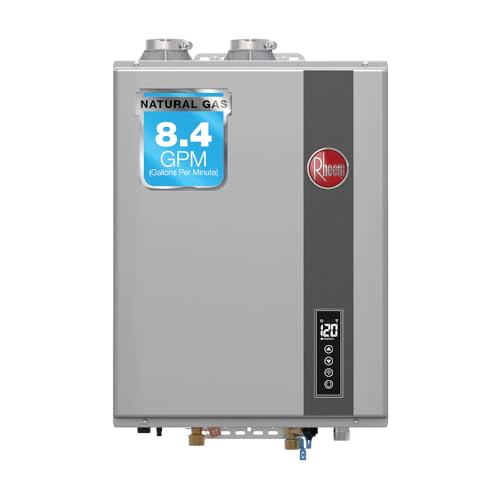
Rheem RTG 8.4 GPM Outdoor Natural Gas Tankless Review
Researched from the DOE test procedures, NFPA 54 and NEC code tables, and manufacturer specifications. Updated .
Quick answer
The Rheem RTG-84's Amazon title lists "8.4 GPM" the same way every other unit in this line does, with no rise stated. What actually separates the RTG-84 from its indoor RTGH sibling is not flow, it is mounting: this unit installs outside, on an exterior wall, with no flue, no chimney, no vent pipe run through the attic or the roof.
That single fact changes the installation math more than the BTU rating does, and it introduces a tradeoff most listings do not spell out: freeze exposure. This review covers what the 180,000 BTU input actually produces at realistic rises, who an outdoor unit suits, and where the freeze risk becomes the deciding factor.
What the specifications actually say
The listing publishes a 180,000 BTU input, non-condensing operation, natural gas fuel, outdoor mounting and a maximum flow figure of 8.4 GPM with no rise stated. It does not publish a UEF, dimensions, weight or minimum activation flow. Using the published BTU input and an assumed 82 percent thermal efficiency for a non-condensing unit, here is what that input produces across a range of rises.
| Temperature rise | Assumed flow (GPM) | A scenario that rise represents |
|---|---|---|
| 30 F | 9.8 | A warm-climate summer inlet, the scenario this unit is built for |
| 50 F | 5.9 | A mild winter, still within the intended climate for an outdoor unit |
| 70 F | 4.2 | A cold winter inlet, uncommon in the climates where an outdoor unit makes sense |
| 90 F | 3.3 | A very cold inlet, the climate this unit is not built for |
Published standard Source: 180,000 BTU input from the Amazon listing. GPM computed from Q = BTU x efficiency / (rise x 8.33 x 60), with an 82 percent non-condensing efficiency assumed rather than measured.. The rise rows toward the bottom of this table describe a climate an outdoor unit generally should not be installed in at all, for freeze reasons covered below, independent of the flow math.
Who this unit suits
An outdoor non-condensing unit earns its keep in a warm climate retrofit where the real cost of an indoor tankless is not the box, it is cutting a flue path through a roof or an exterior wall and running category III stainless the whole way. Mounting outdoors on an exterior wall skips that entirely: the intake and exhaust are both immediately at the unit. That is a genuine, sizeable installation saving in the right climate.
It also suits a straightforward gas line retrofit where 180,000 BTU is within what the existing service and meter can support, checked against the gas line size calculator rather than assumed.
Who should not buy it
Anywhere winter brings a hard, sustained freeze, an outdoor tankless heater is exposed in a way an indoor unit inside a heated envelope is not. Manufacturers build freeze protection into these units, but that protection depends on continuous electrical power; a winter outage during a hard freeze is exactly the scenario that damages an outdoor unit's internal plumbing. If the property is in a genuinely cold climate, an indoor unit like the RTGH-84 protected inside the building envelope is the safer long-term choice, and our cold climate tankless picks cover that case directly.
Anyone ordering by fuel type without checking twice should also pause here: this is the natural gas version, and the propane RTG-70 outdoor sibling looks nearly identical on the page. The two are not interchangeable.
What the installation actually involves
The headline advantage is also the whole installation: mounting on an exterior wall with direct intake and exhaust, no flue pipe run through the house at all. What remains is sizing the gas line for the full 180,000 BTU input, which is the same NFPA 54 / IFGC capacity table exercise as any other gas appliance and does not get easier because the unit sits outside. A gas connector rated for outdoor and appliance-flex use, plus isolation valves for the annual descale, are the accessory layer this unit actually needs, since it has no vent kit to buy.
Freeze protection heater elements inside the unit need continuous power; if the property loses power during a hard freeze, that protection stops working. This is a real limitation, not a footnote, in any climate that sees sustained sub-freezing temperatures. Installation labor cost estimating belongs to houseprojectcalc.com, not this review.
How we researched this
We did not install this unit outdoors, run it through a freeze cycle or measure its flow. This review is compiled from Rheem's published listing specifications and the consensus of verified owner reviews on the same listing, plus the general engineering relationships common to non-condensing gas tankless heaters. Freeze exposure is a widely documented characteristic of outdoor tankless units generally, not a claim specific to hands-on testing of this model.
Alternatives and what the outdoor install needs
The propane version of this same chassis is the most common ordering mistake on this listing. The two accessories below are what an outdoor gas connection actually needs.
Rheem RTGH 8.4 GPM Natural Gas Indoor
$1,168.99The condensing indoor sibling, for a house where the flue can be routed and the higher efficiency and PVC venting are worth the tradeoff over going outdoor.
Best for: The common two to three bathroom whole house replacement
Check price on Amazon
Rheem RTG 7.0 GPM Propane Outdoor
$770.17The propane version of the same outdoor chassis, for a property with no natural gas service. Gas and propane units are not interchangeable or field convertible.
Best for: Propane properties with no natural gas service
Check price on Amazon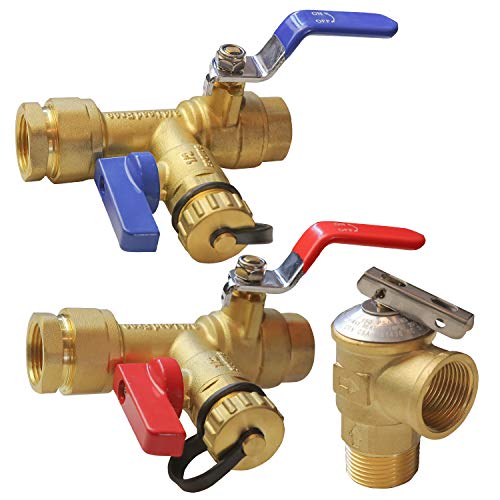
Hourleey 3/4 in IPS Isolator Valve Kit
$49.99An isolation valve kit at the unit is what makes an annual descale possible without disturbing the gas or water supply lines.
Best for: Retrofitting valves to an existing unit
Check price on Amazon
EZ-Fluid 24 in Full Port Gas Flex, 3/4 in
$26.99A flexible gas connector sized for the final run to the unit, rather than relying on rigid pipe threaded all the way to the appliance.
Best for: A gas tankless unit
Check price on AmazonFrequently asked questions
- Does the Rheem RTG-84 outdoor unit need a flue?
- No. Mounting outdoors on an exterior wall is what removes the flue requirement entirely, since intake and exhaust both happen directly at the unit rather than through a vent pipe run inside the building. That is the primary reason to choose an outdoor unit over an indoor one in a climate where it makes sense.
- Is the Rheem RTG-84 safe to install in a cold climate?
- An outdoor tankless unit's freeze protection depends on continuous electrical power, so a winter power outage during a hard freeze can damage its internal plumbing. In climates with sustained sub-freezing winters, an indoor unit protected inside the building envelope is the safer choice.
- What is the difference between the Rheem RTG-84 and the RTG-70?
- The RTG-84 is rated at 180,000 BTU with an 8.4 GPM listed maximum flow, while the RTG-70 in this outdoor line is rated at 160,000 BTU with a 7.0 GPM listed maximum. The RTG-70 outdoor is also sold in a propane version, which is a separate, non-interchangeable model from the natural gas RTG-84.
- Does an outdoor tankless heater need a condensate neutralizer?
- The RTG-84 is non-condensing, so it produces no condensate and needs no neutralizer. That is one of the tradeoffs against a condensing indoor unit like the RTGH-84, which is more efficient but requires condensate drainage and a neutralizer.
- Can I convert the Rheem RTG-84 from natural gas to propane?
- No. Rheem sells the natural gas and propane versions of this outdoor chassis as separate models, and this listing is not field convertible between fuels. Ordering the wrong fuel version is one of the most common mistakes on this product line.
- What size gas line does a 180,000 BTU tankless heater need?
- The correct pipe size depends on the total length of the run and the number of fittings between the meter and the unit, sized against NFPA 54 / IFGC capacity tables rather than assumed from an existing line. Use the gas line size calculator with the unit's 180,000 BTU input and your actual run length.
Safety note: gas line sizing and the final gas connection belong to a licensed plumber or gas fitter. Never assume an existing gas line is adequate for a new appliance's BTU input without checking it against a capacity table.