Expansion Tanks
Expansion Tank Sizing Chart
Researched from the DOE test procedures, NFPA 54 and NEC code tables, and manufacturer specifications. Updated .
Quick answer
A closed water heater system, one with a check valve, backflow preventer or pressure reducing valve somewhere ahead of it, has nowhere for heated water to expand except back through the T&P valve unless an expansion tank is installed. This page works the two calculations that size that tank: how many gallons the water itself expands by, and how much larger than that the tank's acceptance volume has to be once its own internal air charge is accounted for.
Both figures come from published physical relationships rather than a rule of thumb, and the expansion tank size calculator runs the same formulas for a tank size and pressure not listed in the tables below.
Every heating cycle repeats this expansion and contraction, not just the first time the tank is filled. A correctly sized expansion tank absorbs that cycle quietly for years; an undersized one, or a system with no expansion tank at all, forces the T&P relief valve to do that job instead, which is a repeated mechanical stress the valve was never designed to absorb as routine operation.
How much does water expand when a tank heats from 50 F to 140 F?
Water gets less dense as it warms, so a fixed mass of it takes up more volume hot than cold. At 50 F, water weighs about 62.41 pounds per cubic foot; at 140 F it weighs about 61.38 pounds per cubic foot. The ratio of those two figures, 62.41 divided by 61.38 minus 1, works out to an expansion fraction of about 0.0168, or 1.68 percent of the tank's volume.
| Tank size | Density at 50 F | Density at 140 F | Expansion fraction | Expansion volume |
|---|---|---|---|---|
| 30 gal | 62.41 lb/ft3 | 61.38 lb/ft3 | 1.68% | 0.50 gal |
| 40 gal | 62.41 lb/ft3 | 61.38 lb/ft3 | 1.68% | 0.67 gal |
| 50 gal | 62.41 lb/ft3 | 61.38 lb/ft3 | 1.68% | 0.84 gal |
| 66 gal | 62.41 lb/ft3 | 61.38 lb/ft3 | 1.68% | 1.11 gal |
| 75 gal | 62.41 lb/ft3 | 61.38 lb/ft3 | 1.68% | 1.26 gal |
| 80 gal | 62.41 lb/ft3 | 61.38 lb/ft3 | 1.68% | 1.34 gal |
Published standard Source: Water density at 50 F (62.41 lb/ft3) and 140 F (61.38 lb/ft3), a standard reference figure; expansion fraction = 62.41 / 61.38 minus 1 = 0.0168, applied directly to nameplate tank volume.. This is the volume the water itself gains, before accounting for how much larger the expansion tank needs to be once its internal air charge is factored in, which the next table works out.
How much bigger does the expansion tank need to be than the expansion volume?
An expansion tank is not a simple bucket for the extra volume; it holds a sealed air charge behind a diaphragm, and that air compresses as water pushes into the tank, so the tank's total acceptance volume has to be larger than the expansion volume itself. The standard formula is Vt = Ve / (1 minus (Pi + 14.7) / (Pf + 14.7)), where Ve is the expansion volume, Pi is the static supply pressure, and Pf is the relief valve setting, commonly 150 psi on a residential T&P valve.
| Tank size | Expansion volume | At 40 psi | At 50 psi | At 60 psi | At 70 psi | At 80 psi |
|---|---|---|---|---|---|---|
| 30 gal | 0.50 gal | 0.75 gal | 0.83 gal | 0.92 gal | 1.04 gal | 1.19 gal |
| 40 gal | 0.67 gal | 1.01 gal | 1.11 gal | 1.23 gal | 1.38 gal | 1.58 gal |
| 50 gal | 0.84 gal | 1.26 gal | 1.38 gal | 1.54 gal | 1.73 gal | 1.98 gal |
| 66 gal | 1.11 gal | 1.66 gal | 1.83 gal | 2.03 gal | 2.28 gal | 2.61 gal |
| 75 gal | 1.26 gal | 1.89 gal | 2.08 gal | 2.31 gal | 2.59 gal | 2.96 gal |
| 80 gal | 1.34 gal | 2.01 gal | 2.21 gal | 2.46 gal | 2.77 gal | 3.16 gal |
Published standard Source: Vt = Ve / (1 - (Pi + 14.7) / (Pf + 14.7)), with Pf held at 150 psi, the standard relief valve setting on a residential T&P valve, and Pi taken as the static supply pressure in each column.. Static supply pressure, not a peak reading, is the correct input; check it at an outdoor spigot with the system otherwise at rest.
Which size expansion tank should I actually buy?
Required acceptance volume rarely matches a tank's exact rated size, so the practical step is rounding up to the nearest commonly sold model with some headroom rather than buying to the decimal.
| Tank size | Required at 50 psi | Tank to buy | Required at 80 psi | Tank to buy |
|---|---|---|---|---|
| 30 gal | 0.83 gal | 2 gal | 1.19 gal | 2 gal |
| 40 gal | 1.11 gal | 2 gal | 1.58 gal | 2 gal |
| 50 gal | 1.38 gal | 2 gal | 1.98 gal | 2 gal |
| 66 gal | 1.83 gal | 2 gal | 2.61 gal | 4.5 gal |
| 75 gal | 2.08 gal | 4.5 gal | 2.96 gal | 4.5 gal |
| 80 gal | 2.21 gal | 4.5 gal | 3.16 gal | 4.5 gal |
Convention Source: Required volume from the table above, rounded up to the nearest commonly sold expansion tank size among 2, 4.5, 6, 8.5 and 14 gallon nominal models, chosen with headroom rather than an exact match.. A row that lands close to a size boundary, such as 66 gallons at 80 psi, is worth sizing up rather than down; oversizing an expansion tank causes no harm beyond the extra mounting space it takes.
Does the tank pre-charge setting matter?
Yes, and it is the step most often skipped. An expansion tank ships with a factory air pre-charge, typically around 40 psi, and that pre-charge has to be adjusted to match the actual static supply pressure at the installation before the tank is plumbed in. If the pre-charge is left at the factory setting on a system running at 60 or 70 psi, the tank accepts less water before its diaphragm bottoms out than the sizing table above assumes, which defeats the calculation entirely. Check and set the pre-charge with a standard tire gauge and a bicycle-style pump at the tank's air valve, with the system depressurized and the tank empty of water.
A tank installed with the correct pre-charge still needs to sit with its air side able to compress freely; mounting it upside down, or on a run with a check valve trapping water against it, can leave the diaphragm unable to move the way the sizing calculation assumes. A tee installed directly on the cold supply line near the water heater, with the tank hanging from it, is the standard orientation.
Re-check the pre-charge yearly. A slow air leak past the diaphragm shrinks the effective acceptance volume gradually, long before the tank fails outright.
How do I know if an expansion tank has already failed?
The most reliable check does not require any math from the tables above: tap the tank's shell partway up its height. The air side, at the top, sounds hollow; the water side, at the bottom, sounds solid. On a tank with a ruptured diaphragm, the entire shell sounds solid because it has filled completely with water, leaving no air cushion left to absorb expansion at all. A second check is the air valve at the top of the tank, which should read dry air at roughly the pre-charge pressure; water coming out of that valve confirms the diaphragm has failed and the tank needs replacing rather than re-charging.
A failed expansion tank does not usually announce itself directly. It shows up as the same symptom an undersized or missing tank produces, a T&P valve that drips on a cycle, which is why checking the tank itself is worth doing before assuming the valve is at fault.
What if there is no check valve or pressure reducing valve on the supply?
An expansion tank only matters on a closed system, one where a check valve, backflow preventer, pressure reducing valve or the water meter itself blocks heated water from expanding back into the municipal main. On a genuinely open system, expanded water simply pushes back out the way it came in, and the pressure spike that drives this whole calculation does not occur. Many municipal water systems and most PRVs installed at the meter create a closed system without anyone realizing it, which is why the honest first step is confirming whether one of those devices is actually present before assuming the expansion math above even applies.

Expansion Tank Wall Mounting Bracket
$15.99A mounting bracket for a tank installed on an unsupported horizontal run rather than threaded directly onto a tee.
Best for: Every expansion tank installation
Check price on AmazonTanks and fittings by the sizes above
Match the required volume from the tables below to the smallest real tank that covers it, with some headroom rather than an exact fit.

Eastman 2 Gallon Thermal Expansion Tank
$34.98A 2 gallon tank, the size that covers most single-family tanks up to 50 gallons at moderate supply pressure.
Best for: The standard 40 or 50 gallon tank on a closed system
Check price on Amazon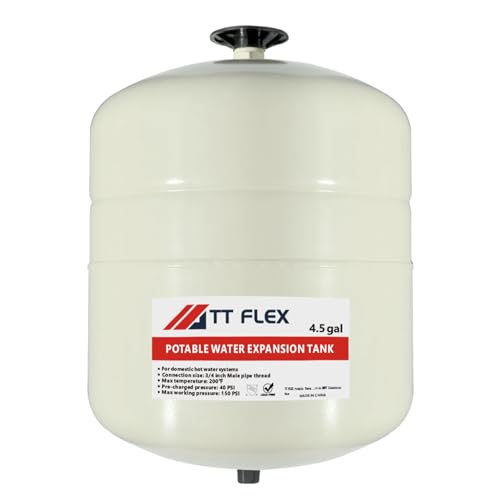
TTFLEX 4.5 Gallon Expansion Tank
$63.64A mid-size option for a larger tank or a higher supply pressure where a 2 gallon model falls short.
Best for: A larger tank on a budget
Check price on Amazon
Amtrol ST-12 Thermal Expansion Tank
$127.03The largest option in this lineup, for a large storage tank paired with a high supply pressure near 80 psi.
Best for: An 75 to 80 gallon tank, or a high pressure supply
Check price on Amazon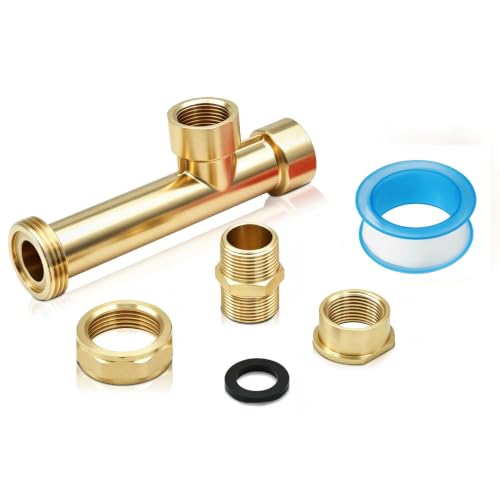
Brass Water Heater Expansion Tee, 3/4 in NPT
$31.59A tee fitting for mounting the expansion tank on the cold supply line where no dedicated port already exists.
Best for: Adding an expansion tank to an existing install
Check price on AmazonFrequently asked questions
- Do I need an expansion tank on every water heater?
- Only on a closed system, one with a check valve, backflow preventer, pressure reducing valve or certain water meters somewhere ahead of the water heater. Those devices stop expanded hot water from pushing back into the street main, so the pressure has to go somewhere, and an expansion tank gives it a place other than the T&P valve.
- What size expansion tank do I need for a 50 gallon water heater?
- It depends on supply pressure. A 50 gallon tank expands by about 0.84 gallons heating from 50 F to 140 F, which requires roughly 1.38 gallons of tank acceptance volume at 60 psi supply, or about 1.98 gallons at 80 psi, against a standard 150 psi relief setting. Either figure typically rounds up to a 2 gallon expansion tank.
- How do I set the pre-charge on an expansion tank?
- Check the static supply pressure at an outdoor spigot with the system at rest, then set the tank's air pre-charge to match that reading using a tire gauge and a pump at the tank's air valve, with the tank empty of water and the system depressurized. A mismatched pre-charge shrinks the tank's effective acceptance volume below what the sizing calculation assumes.
- Why is 150 psi used as the relief valve setting in this calculation?
- 150 psi is the standard factory setting on the T&P relief valve shipped with most residential water heaters, and it is the ceiling the expansion tank sizing formula is designed to keep the system safely under. It is not a number an installer chooses; it comes from the valve itself.
- Can I use a larger expansion tank than the calculation calls for?
- Yes. Oversizing an expansion tank causes no functional problem beyond the extra space it takes to mount, and it adds margin against a supply pressure that creeps upward over time. Undersizing is the failure mode worth avoiding, since it leaves the T&P valve to absorb pressure the tank should have handled.
- What happens if the expansion tank is too small?
- The T&P relief valve starts weeping or dripping periodically as it absorbs the pressure spikes the undersized tank cannot, since the water still has to expand somewhere every heating cycle. Never cap, plug or remove a dripping T&P valve; the fix is a correctly sized expansion tank or a new valve, not blocking the discharge.
An expansion tank is a pressure management device, not an optional accessory once a system is closed. If a T&P valve is dripping, the fix is a correctly sized expansion tank or a replacement valve; never cap, plug or remove the valve itself.