Recovery
Recovery Rate of a 36,000 BTU gas burner at a 80 F Rise
Researched from the DOE test procedures, NFPA 54 and NEC code tables, and manufacturer specifications. Updated .
Quick answer
Recovery rate is gallons per hour a heater reheats. It is half of what a first hour rating is made of, and it is the reason a household with repeated draws through the morning runs out while a household with one big draw does not.
A 36,000 BTU gas burner at 80 percent thermal efficiency puts about 28,800 BTU per hour into the water. Through a 80 F rise that comes to 43.2 gallons per hour.
How 43.2 gallons per hour is arrived at
The relation is the same energy balance used everywhere on this site, rearranged. GPH = BTU per hour x efficiency / (8.33 x rise), so 36,000 x 0.80 / (8.33 x 80) = 43.2.
Note the efficiency term. Thermal efficiency at the burner is not the same as the UEF on the label: UEF is measured over a whole day and includes standby loss, so it is always the lower number.
Recovery across the rise range
| Temperature rise | Recovery | 50 gallon reheat | First hour rating on a 50 gallon tank |
|---|---|---|---|
| 60 F | 57.6 GPH | 52 min | 93 gal |
| 70 F | 49.4 GPH | 61 min | 84 gal |
| 80 F | 43.2 GPH | 69 min | 78 gal |
| 90 F | 38.4 GPH | 78 min | 73 gal |
| 100 F | 34.6 GPH | 87 min | 70 gal |
Published standard Source: Energy relation Q = m x c x dT. The first hour rating column applies the 70 percent usable storage convention, so it is an estimate of a measured value rather than the measured value itself.
How this compares to the alternatives
| Heat source | Recovery | Against this one |
|---|---|---|
| 30,000 BTU gas burner | 36 GPH | 83% |
| 36,000 BTU gas burner | 43.2 GPH | This page |
| 40,000 BTU gas burner | 48 GPH | 111% |
| 50,000 BTU gas burner | 60 GPH | 139% |
| 65,000 BTU gas burner | 78 GPH | 181% |
| 76,000 BTU gas burner | 91.2 GPH | 211% |
| 3,800 watt element | 19.5 GPH | 45% |
| 4,500 watt element | 23 GPH | 53% |
Published standard Source: Energy relation applied to each input rating, gas at 80 percent thermal efficiency. A heat pump water heater in compressor-only mode recovers far slower than any of these, which is why hybrids fall back to resistance elements on a heavy draw.
What a slow recovery actually feels like
It feels like running out on the third shower and then waiting. With a recovery rate of 43.2 gallons per hour, a tank that has been emptied needs about 69 minutes to come fully back. That is not a fault, it is the input rating, and it is why a household that showers in sequence through a long morning needs recovery rate more than it needs storage.
Work out which shape your household has with the peak hour demand calculator, then check the tank against the first hour rating pages.
Gas tanks in this input range

GE RealMAX Choice 40 Gallon Natural Gas
$1,051.49An atmospheric tank vents on buoyancy alone through an existing flue, which is why it is the cheapest gas tank to install and the one most exposed to backdrafting.
Best for: A like-for-like swap into an existing masonry or B-vent flue
Check price on Amazon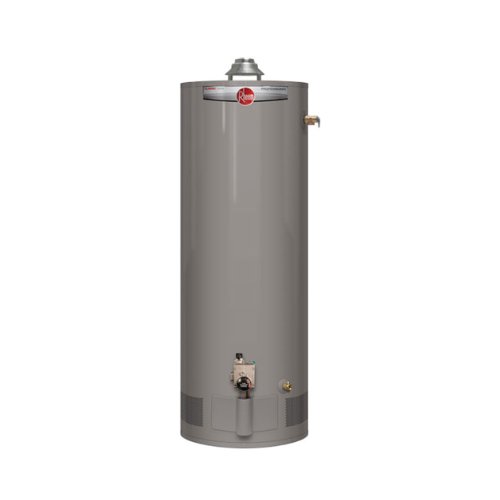
Rheem PROG50-36P 50 Gallon Propane
$1,207.00A 36,000 BTU propane atmospheric tank. The input figure is what sets the recovery rate, and 36,000 BTU is the usual figure on a residential 50 gallon.
Best for: Propane properties replacing an atmospheric tank
Check price on AmazonFrequently asked questions
- What is the recovery rate of a 36,000 BTU gas burner?
- About 43.2 gallons per hour through a 80 F rise at 80 percent thermal efficiency. Recovery falls as the rise climbs, because the same energy has to lift each gallon further, so the same heater recovers noticeably slower in a cold inlet region than in a warm one.
- Is recovery rate the same as first hour rating?
- No. Recovery rate is how fast the heater reheats water, in gallons per hour. First hour rating is the total gallons delivered in one hour starting from full, which combines the usable storage with one hour of recovery. First hour rating is what is printed on the label and what to shop against.
- Why do gas tanks recover faster than electric ones?
- Because a burner puts far more heat into the water than an element does. A 36,000 BTU burner at 80 percent efficiency delivers about 28,800 BTU per hour, while a 4,500 watt element delivers about 15,400. That is roughly double, which is why a 40 gallon gas tank often out-delivers a 50 gallon electric one.
- Do both elements run at the same time on an electric tank?
- No. A standard residential electric tank is non-simultaneous: the upper thermostat gives priority to the upper element, and the lower element only runs once the top of the tank is satisfied. So the recovery rate is set by one element rather than two, which surprises people expecting 9,000 watts from a tank that holds two 4,500 watt elements.
- Can I raise the recovery rate on an existing tank?
- On an electric tank, a higher wattage element raises recovery directly, but only within what the circuit conductors and breaker permit, so it is an electrical question before it is a plumbing one. On a gas tank the burner input is fixed by the unit. On either, a thermostatic mixing valve increases the usable gallons from the same storage, which addresses the same complaint from the other side.
Gas and flue work belongs to a licensed plumber or gas fitter. An undersized gas line starves a burner, and a starved burner produces carbon monoxide. Backdrafting on an atmospheric vent is real, it is invisible, and it kills. Nothing on this page is a substitute for the sizing done by the person who signs the permit, and a working carbon monoxide alarm belongs on every floor of a house with a gas appliance.