Maintenance
Water Heater Lifespan and When to Replace
Researched from the DOE test procedures, NFPA 54 and NEC code tables, and manufacturer specifications. Updated .
Quick answer
A water heater does not usually announce its own death with a single dramatic failure. It leaves a trail of smaller signs first, sometimes for months, before the tank itself lets go. Knowing which signs are cosmetic and which mean the tank is actively failing is the difference between scheduling a calm replacement and mopping up a flooded utility closet.
The tank's lifespan is not fixed by age alone. It is set largely by one small, cheap, and frequently ignored part.
How long does a water heater actually last?
| Type | Typical service life | What usually ends it |
|---|---|---|
| Conventional gas or electric tank | 8 to 12 years | Tank corrosion once the anode rod is consumed |
| Tankless, gas or electric | 20 years or more with regular descaling | Scale buildup and heat exchanger wear, not a sealed steel tank failing |
| Heat pump water heater | Similar range to a conventional tank on the storage side | Tank corrosion on the storage vessel, or compressor wear over a long service life |
Convention Source: Commonly cited service-life ranges from manufacturer literature and industry maintenance guidance; actual lifespan varies with water chemistry, maintenance and usage.. These are typical ranges, not guarantees. A neglected tank in hard water can fail well inside 8 years; a well-maintained one can run past 12.
Why does the anode rod decide when a tank fails?
A sacrificial anode rod is a metal rod, commonly magnesium or aluminum, suspended inside the tank and wired electrically to the steel shell. Corrosion is an electrochemical process, and the anode rod is deliberately the more reactive metal in that circuit, so it corrodes first and protects the tank's glass lining and steel shell instead. Once the rod is fully consumed, usually after several years depending on water chemistry, that protection stops, and the tank's own steel becomes the next thing corrosion attacks. From that point, the tank is on a countdown that ends in a pinhole leak or a full failure, not a gradual, stoppable process.
What are the warning signs a tank is near the end?
Rusty or discolored hot water, especially if it clears after running the tap for a minute, points to internal corrosion rather than a supply-line problem. A rumbling, popping or knocking sound during heating usually means sediment has built up on the tank bottom, insulating the burner or element from the water above it and stressing the tank. A relief valve that weeps even when the tank has been idle can point to a tank problem rather than only a pressure problem, and any moisture, rust staining or standing water at the base of the tank is the most urgent sign of all, since it can mean the tank itself has already begun to leak.
What do I do about a rumbling tank or discolored water?
Sediment-related rumbling is addressed with a tank flush, covered in the how to flush a water heater guide, and it is worth doing before assuming the tank is failing outright. Persistent rusty water that does not clear after flushing, especially paired with the tank's age approaching the 8 to 12 year range, points toward internal corrosion rather than sediment alone, which sediment flushing cannot reverse.
Why does replacing before failure beat replacing after a flood?
A tank that fails suddenly rather than gradually typically does so at the seams or through the shell itself, releasing its full stored volume at once onto whatever floor it sits on. A scheduled replacement, done because the anode rod is long past due or the tank is showing early warning signs, costs the same water heater but avoids water damage to flooring, drywall, stored belongings and anything below the install location. The relative cost of a calm replacement against an emergency one, and what a professional installation runs, is covered by HouseProjectCalc's installation cost guidance rather than here.
A weeping relief valve is a warning, not a nuisance to seal off. If a relief valve drips, the correct response is diagnosing the pressure or temperature cause and installing a new valve if it will not reseat, never covering it, plugging it or removing it, since it is the last safety device standing between a sealed tank of hot pressurized water and a serious failure.
The part that decides tank lifespan, and what comes after it
Checking and replacing the anode rod on schedule is the single highest-leverage maintenance task on a tank water heater. A leak detector is the cheap insurance for the day that maintenance was skipped too long.

Eastman 42 in Flexible Magnesium Anode
$35.25A standard magnesium sacrificial anode rod, the conventional replacement part for most residential tank water heaters.
Best for: A tank with a low ceiling above it
Check price on Amazon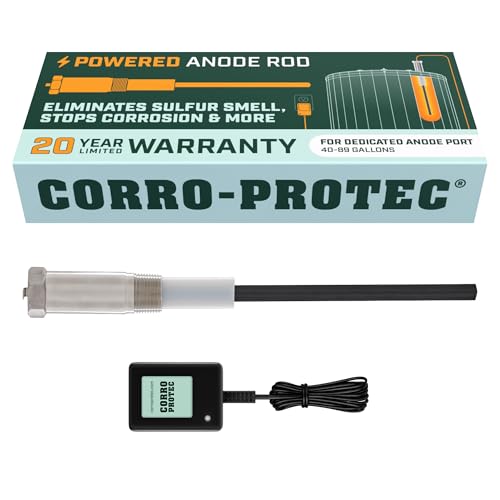
Corro-Protec Powered Anode Rod
$179.95A powered titanium anode that protects the tank electrically without physically wearing away, so there is nothing to inspect or replace on a schedule.
Best for: Hard water, or a tank you intend to keep
Check price on Amazon
FloodStop Water Heater Leak Kit, 3/4 in NPT
$202.85An automatic water shutoff kit that closes the supply if a tank does eventually fail, limiting a leak to a puddle instead of a flood.
Best for: An upstairs or finished space installation
Check price on AmazonFrequently asked questions
- How many years does a typical water heater last?
- A conventional gas or electric storage tank typically lasts 8 to 12 years before internal corrosion ends its service life, while a well-maintained tankless unit is commonly cited as reaching 20 years or more, since it holds no standing reservoir of water to corrode from the inside the same way a tank does.
- What does the anode rod actually do inside a water heater?
- A sacrificial anode rod, usually magnesium or aluminum, corrodes in place of the tank's steel shell through an electrochemical process, protecting the tank's lining for as long as the rod itself lasts. Once it is fully consumed, the tank's own metal becomes the next target of corrosion, which is why checking and replacing the rod is the single highest-leverage maintenance task on a tank water heater.
- Is rusty hot water always a sign the tank is failing?
- Not always, but it is a warning sign worth investigating. Discolored water that clears after running the tap briefly can point to sediment or an aging anode rod rather than a failed tank shell, especially on a younger unit, but rusty water combined with a tank near or past 8 to 12 years old points more strongly toward internal corrosion.
- What does a rumbling or popping sound from a water heater mean?
- It usually means sediment has settled on the bottom of the tank and is being disturbed by heating, trapping water pockets that pop as they boil against the tank floor. A tank flush often resolves it if caught early; sediment left in place for years can accelerate wear on the tank and the burner or element.
- Should I replace a water heater before it actually fails?
- Yes, once clear warning signs appear, such as an anode rod long overdue for replacement, persistent rusty water, or moisture at the tank base. A scheduled replacement costs the same equipment as an emergency one but avoids the water damage, cleanup and disruption of a tank that fails suddenly and releases its full stored volume.
- Does a tankless water heater have an anode rod that needs replacing?
- No. A tankless unit has no standing reservoir of water and no sacrificial anode rod, so its service life is governed instead by mineral scale buildup on the heat exchanger and general component wear, which is why regular descaling, rather than anode replacement, is the maintenance task that determines how long a tankless unit lasts.
Check the anode rod on a schedule, not after a problem shows up. An anode inspected and replaced before it is fully consumed can meaningfully extend a tank past the typical 8 to 12 year range, and it is the cheapest maintenance step on the entire appliance relative to what a full replacement costs.