Tankless
Whole House vs Point of Use Tankless Water Heater
Researched from the DOE test procedures, NFPA 54 and NEC code tables, and manufacturer specifications. Updated .
Quick answer
These two categories share the word tankless and the general on-demand heating principle, and that is where the similarity ends. One is sized to cover a household's combined peak flow across every fixture that might run at once. The other is sized to eliminate a wait at a single tap. Buying one where the other is needed leaves the actual problem unsolved.
What problem does a point of use tankless heater actually solve?
In a house where a bathroom, a garage sink or a laundry tub sits a long pipe run from the main water heater, the water sitting in that pipe cools between uses, so opening the tap draws out that cooled water before anything hot arrives, sometimes for a long stretch of the pipe's full length. A small point of use unit installed at or near that fixture heats water right there, eliminating the wait created by distance rather than the wait created by the main heater's own recovery limits.
What problem does a whole-house tankless heater actually solve?
A whole-house tankless unit replaces the tank or previous heater serving the entire home and is sized against the home's peak combined demand, meaning it needs to cover the highest number of fixtures likely to run hot water at the same time. It solves running out of hot water entirely, at the cost of a flow-rate ceiling if too many fixtures draw at once, a limit the peak hour demand calculator works out for a specific household.
How different are the flow ratings, really?
| Category | Typical flow rating | Typical install location | Can it replace the main water heater? |
|---|---|---|---|
| Point of use tankless | Roughly 1 to 3 GPM at a modest rise | Under a sink, in a cabinet, or close to one fixture | No, it serves one fixture or a small zone |
| Whole-house tankless | Roughly 4 GPM or more at a full rise | Central mechanical space, exterior wall, or dedicated utility area | Yes, sized against the home's combined peak demand |
Convention Source: Manufacturer specification ranges for the point of use and whole-house tankless models in this catalog.. A specific model's rated flow depends on the incoming water temperature and the target output temperature; check the manufacturer's GPM-at-rise chart for the exact unit.
When is a point of use tankless heater the right call?
A single distant bathroom, a workshop or garage sink, a wet bar, or any fixture separated from the main heater by a long pipe run are the clearest cases, especially where running a dedicated hot water line back to the main heater is impractical or a full recirculation system is not worth installing for one fixture. A point of use unit here supplements the existing water heater rather than replacing anything.
When is a whole-house tankless heater the right call?
Replacing an aging tank water heater, covering a household where multiple fixtures regularly run hot water at the same time, or wanting to eliminate a tank's storage limit entirely are the cases a whole-house unit is built for. Sizing it correctly against combined peak flow, not against a single fixture's needs, is what keeps it from becoming an expensive point of use heater that only covers one shower at a time.
What does each choice cost you later?
A single point of use unit costs less up front than a whole-house model, but covering several distant fixtures with several separate point of use units can add up to as much as, or more than, one correctly sized whole-house heater, while still leaving the main tank or heater as the household's primary hot water source. A whole-house unit costs more up front and needs the same descaling, and for a gas model the venting maintenance, that applies to any tankless unit, but it is the only one of the two that actually replaces the main heater.
Point of use options, and a whole-house unit for scale
The first three solve a single-fixture distance problem. The last one is what actually replaces a main water heater.

Rheem RTEX-06T 6.5kW Point of Use
$189.00A compact electric point of use unit sized for a single distant fixture rather than whole-house duty.
Best for: A remote sink on a 240 volt circuit
Check price on Amazon
Eemax SPEX35 3.5kW 240V
$247.99A small under-sink style unit for eliminating wait time at one bathroom or utility sink.
Best for: A remote sink where a 240 volt circuit already exists
Check price on Amazon
Stiebel Eltron DHX 12-2 Trend 12kW
$266.14A higher-output point of use unit that can cover a sink and a nearby shower on the same short run.
Best for: A remote shower with its own circuit
Check price on Amazon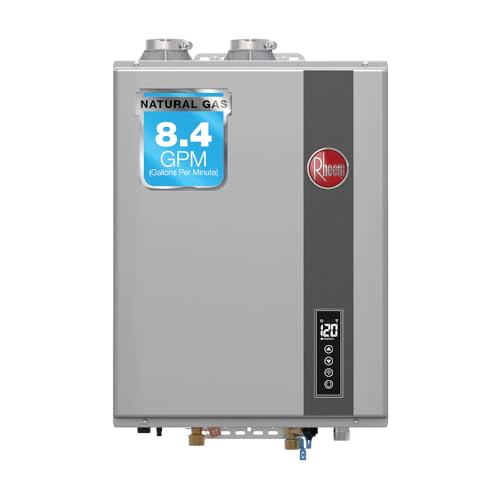
Rheem RTGH 8.4 GPM Natural Gas Indoor
$1,168.99A whole-house gas tankless unit included here for contrast, sized to replace the main water heater entirely.
Best for: The common two to three bathroom whole house replacement
Check price on AmazonFrequently asked questions
- Can a point of use tankless water heater supply a whole house?
- No. Point of use units are typically rated for only 1 to 3 gallons per minute at a modest temperature rise, enough for one fixture or a small zone, well short of what a shower running alongside a dishwasher or washing machine needs. Using one as a whole-house replacement leaves most fixtures without adequate hot water.
- What is the actual problem a point of use tankless heater fixes?
- It fixes the wait caused by distance: water sitting in a long pipe run between the main water heater and a distant fixture cools between uses, so the tap has to draw that cooled water out before hot water arrives. A point of use unit installed near that fixture heats water right there instead, removing the wait tied to pipe length.
- Can I use a point of use heater instead of replacing my main water heater?
- Not as a full replacement in a typical house. A point of use unit's flow rating covers a single fixture or small zone, a fraction of a household's combined peak demand, so it can supplement an existing water heater at one distant location but is not built to cover simultaneous whole-house use on its own.
- Do point of use tankless heaters need their own dedicated circuit?
- Most electric point of use units need a dedicated circuit sized to that specific model's amperage draw, though the smallest single-fixture models sometimes run on a shared standard circuit. Checking the nameplate rating on the specific unit against the water heater breaker size calculator before wiring avoids an undersized circuit.
- Is a point of use tankless heater cheaper than a whole-house unit?
- A single point of use unit costs less than a whole-house model, but it only covers one fixture or a small zone. Installing several point of use units to cover several distant fixtures in the same house can end up costing as much as, or more than, one correctly sized whole-house tankless heater.
- What is the cold water sandwich effect, and does a point of use heater have it?
- The cold water sandwich effect is a brief pulse of cold water between two hot draws on a tankless unit as it reheats between uses, most noticeable on whole-house units serving a long pipe run. A point of use unit installed close to its one fixture largely avoids it there, since the pipe run it has to cover is short.
Match the unit to the job, not the other way around. A point of use heater solving a distance problem and a whole-house heater covering total demand are different purchases with different sizing math, and neither substitutes for the other.