Venting
Atmospheric vs Power Vent Water Heater
Researched from the DOE test procedures, NFPA 54 and NEC code tables, and manufacturer specifications. Updated .
Quick answer
Every gas storage water heater has to get combustion exhaust out of the building, and there are only two ways to do it. An atmospheric vent relies on hot exhaust gas rising on its own through a vertical flue, the same way a fireplace draws. A power vent unit forces the exhaust out with an integral blower, usually sideways through a wall in PVC or CPVC pipe rather than up through a chimney.
The choice is not really a preference. It is decided by whether a usable flue already exists at the install location, and it changes what the tank needs from the room around it.
What actually separates an atmospheric vent from a power vent?
The International Fuel Gas Code classifies gas water heater venting into categories, and the two that matter for a residential tank are Category I, natural draft, and Category III, forced draft with a fan. The table below lines up the practical differences a homeowner or plumber deals with, not just the code label.
| Trait | Atmospheric vent | Power vent |
|---|---|---|
| Draft mechanism | Natural buoyancy up an existing flue | Integral blower forces exhaust out |
| Vent material | Masonry chimney or type B double wall metal | Schedule 40 PVC or CPVC per the manufacturer manual |
| Existing chimney required | Yes | No |
| Electrical requirement for venting | None | Dedicated outlet for the blower and pressure switch |
| Backdraft risk | Real, worsens with other exhaust fans or a weak flue | Essentially eliminated, the fan forces the exhaust out |
| Failure that is specific to the type | Spillage or backdrafting into the room | Blower motor or pressure switch failure, which shuts the unit down rather than venting improperly |
| Typical fit | Like for like swap into a working masonry or B vent flue | A basement or interior room with no usable flue at all |
Published standard Source: International Fuel Gas Code (IFGC) Category I and Category III vent classifications; GE RealMAX and A.O. Smith GPVX-50L installation manuals.. Category numbers describe draft type and condensate potential. They are a code classification, not a brand or a marketing term.
When is an atmospheric vent water heater the right call?
An atmospheric tank is the right choice when a masonry or type B flue is already in place and drafting correctly, because it is a like for like swap with no new venting to run and the lowest equipment cost of the two. It also suits a home where the water heater shares a flue with a furnace or boiler that was sized for that shared load, since replacing the tank does not disturb that arrangement.
It is the wrong choice when the room has been tightened up with new exhaust fans, a fireplace insert or an added dryer vent, because any of those can depressurize the space enough to pull exhaust back down the flue instead of letting it rise. A flue that has not been inspected in years is a reason to have it checked before assuming it still drafts the way it did when the last tank was installed.
When is a power vent water heater the right call?
A power vent unit like the A.O. Smith GPVX-50L is the right call when there is no usable flue at all, which is common in a basement mechanical room, an interior closet, or any layout where running a vertical chimney would mean cutting through floors that were never built for it. Because the blower routes exhaust sideways in plastic pipe, the water heater can sit almost anywhere with a clear path to an exterior wall.
It is the wrong call for a location with no nearby outlet and no interest in adding one, and it adds one more electromechanical part, the blower, that a purely atmospheric design does not have. When that blower fails, the unit's pressure switch is designed to shut combustion down rather than let exhaust spill, which is the safe failure but still means no hot water until it is repaired.
What does each one cost you later, after the install?
An atmospheric tank's ongoing cost is mostly the anode rod and the tank itself; venting has almost no moving parts to wear out, but it depends on the rest of the house staying the way it was when the flue was sized. Adding exhaust fans, a new fireplace, or sealing up the house for efficiency can change how that flue performs years after the tank went in, and that is a maintenance item nobody schedules because it is invisible until something goes wrong.
A power vent tank adds the blower and its pressure switch as parts with a finite service life, on top of the same anode rod and tank wear every gas heater has. Replacing a blower motor down the road is a real but infrequent cost, and it only affects the vent system, not the tank's ability to heat water. Neither design changes descale needs, since that is a tankless subject, not a tank one.
The two paths, by unit
Both routes are represented in the tank-gas catalog. The atmospheric option comes in natural gas and propane, and the power vent option is a single 50 gallon unit built around the blower.

GE RealMAX Choice 40 Gallon Natural Gas
$1,051.49A 40 gallon atmospheric tank sized for a straightforward swap into an existing masonry or B vent flue. See the <a href="/reviews/ge-realmax-40-review">full review</a>.
Best for: A like-for-like swap into an existing masonry or B-vent flue
Check price on Amazon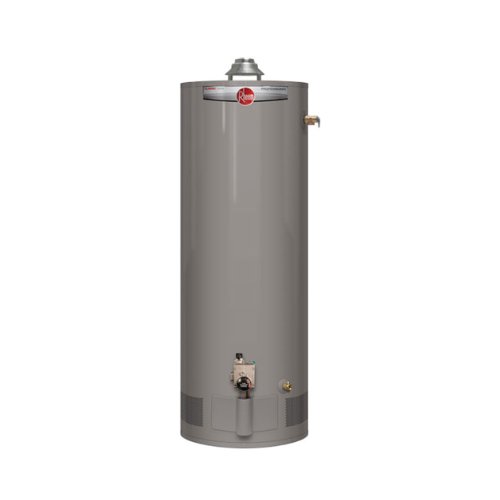
Rheem PROG50-36P 50 Gallon Propane
$1,207.00The propane version of the same atmospheric concept at 50 gallons, for a property with no natural gas service.
Best for: Propane properties replacing an atmospheric tank
Check price on Amazon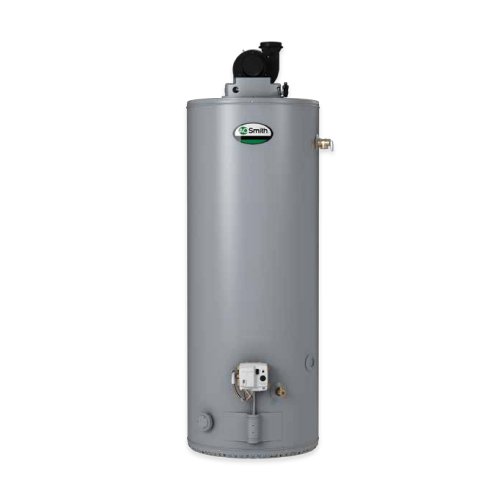
A.O. Smith GPVX-50L ProMax SL Power Vent
$2,199.00A 50 gallon power vent tank that needs no chimney at all, reviewed in full at the <a href="/reviews/aosmith-gpvx-50l-review">A.O. Smith GPVX-50L review</a>.
Best for: Basements with no usable flue
Check price on AmazonFrequently asked questions
- Can I convert an atmospheric water heater to power vent myself?
- No. Converting a tank from atmospheric to power vent, or the reverse, means changing the flue path, the vent material and often the gas control, which is gas appliance and venting work that belongs to a licensed plumber or gas fitter. Backdrafting from a mismatched conversion is invisible while it happens, and carbon monoxide from improper venting is a documented cause of injury and death, not a theoretical risk.
- How do I know if my atmospheric water heater is backdrafting?
- Signs include soot or moisture staining around the draft hood, a musty or exhaust smell near the tank, a pilot or burner flame that looks yellow or unstable, and condensation on nearby surfaces. Because carbon monoxide itself has no smell, these visible signs matter, but the only reliable check is a combustion analyzer draft test, which is a job for a licensed technician, not a homeowner inspection.
- Does a power vent water heater need a dedicated electrical circuit?
- It needs a standard outlet for the integral blower and control board, per the manufacturer installation manual for units like the A.O. Smith GPVX-50L, though the specific circuit requirement should be confirmed against that manual and local code rather than assumed. This is separate from any circuit an electric water heater would need, since the power vent's outlet only runs the fan and controls, not the heating itself.
- Why is an atmospheric water heater cheaper to buy than a power vent unit?
- An atmospheric tank has fewer parts: no blower, no pressure switch, no PVC vent kit. The GE RealMAX Choice 40 gallon atmospheric unit and the A.O. Smith GPVX-50L power vent unit both heat water the same way, but the power vent design adds a forced draft system that atmospheric venting does not need, which is reflected in the equipment cost, separate from whatever the installation itself runs.
- Can a power vent tank be installed anywhere in the house?
- It can go almost anywhere with a clear path to an exterior wall for the PVC or CPVC vent pipe, since it does not depend on a vertical chimney. It still needs to meet the manufacturer's maximum vent length and the required clearances to windows, doors and other openings on the exterior wall, which are set in the installation manual and local code, not left to judgment on site.
- What is the actual failure mode difference between the two vent types?
- An atmospheric vent fails quietly: a weak or blocked flue can let exhaust spill into the room without shutting the burner off, which is what makes backdrafting dangerous. A power vent unit fails safely: if the blower or its pressure switch stops working correctly, the control board shuts combustion down rather than allowing exhaust to spill, at the cost of no hot water until the blower is repaired.
Backdrafting on an atmospheric vent is real and it is invisible. Carbon monoxide from improper venting kills, and it has no smell to warn anyone before it does. Flue inspection, venting changes and any conversion between atmospheric and power vent belong to a licensed plumber or gas fitter, not a weekend project. If a flue has not been checked in years, that check is worth doing before assuming it still drafts the way it did when the last tank went in.