Tankless sizing
What Size Tankless Water Heater for 1 Fixture at a 60 F Inlet?
Researched from the DOE test procedures, NFPA 54 and NEC code tables, and manufacturer specifications. Updated .
Quick answer
A tankless water heater is sized by flow and temperature rise together. Neither number means anything alone, which is why a unit advertised at a large flow figure disappoints in a cold region: the advertised figure is measured at a small rise that almost nobody has.
At a 60 F inlet, reaching a 120 F outlet is a 60 F rise. Pushing 2 gallons per minute through that rise takes 73,000 BTU per hour of gas at 82 percent efficiency. The tankless sizing calculator runs this with your own numbers.
Why 2 gallons per minute for 1 fixture?
Two gallons per minute per fixture is a planning figure for a modern shower head, which is what most simultaneous draws actually are. A 2.5 gallon per minute head pushes it up, a 1.75 gallon per minute head pulls it down, and a tub filling pulls it up sharply because tub spouts have no federal flow limit.
Size for the fixtures that genuinely run at the same time, not for every fixture in the house. Sizing for all of them buys an enormous unit, an enormous gas line and a bill for a scenario that never happens.
What 60 F of rise costs you in flow
The rise sits in the denominator, so it trades against flow directly. This is the same unit at every rise, not different units.
| Gas input | At a 35 F rise | At 60 F | At a 90 F rise |
|---|---|---|---|
| 120,000 BTU/h | 5.6 GPM | 3.3 GPM | 2.2 GPM |
| 150,000 BTU/h | 7 GPM | 4.1 GPM | 2.7 GPM |
| 180,000 BTU/h | 8.4 GPM | 4.9 GPM | 3.3 GPM |
| 199,000 BTU/h | 9.3 GPM | 5.4 GPM | 3.6 GPM |
Published standard Source: GPM = BTU per hour x efficiency / (rise x 8.33 x 60), at an assumed 82 percent thermal efficiency. Amazon listing titles state a flow figure with no temperature rise attached, so that figure cannot be compared against this table. Take the flow curve from the manufacturer installation manual.
Gas or electric for this load
The same load in two currencies. The electric figure is what makes whole house electric tankless impractical in most houses.
| Fuel | Input needed | What that means |
|---|---|---|
| Natural gas or propane | 73,000 BTU/h | Within the residential range, subject to the gas line |
| Electric | 17.9 kW | About 75 amps at 240 volts, before the continuous load factor |
Published standard Source: Energy relation applied at 82 percent gas efficiency and 98 percent electric efficiency. NEC 422.13 makes this a continuous load, so the electrical circuit is sized at 125 percent of that current. See the breaker and wire pages.
Check the gas line before you buy the unit
A 73,000 BTU appliance draws about 71 cubic feet of natural gas per hour. Over a 40 foot run at a half inch water column drop the NFPA 54 table gives 3/4 inch pipe 170 cubic feet per hour, so a 3/4 inch run covers it at that length.
The gas line size calculator and the gas pipe size pages cover this properly. Gas line upsizing is routinely the largest single line in a tankless quote and the one most often missed.
Gas tankless units in this input range
Verified listings. Note that the flow figure in each listing title is a maximum at a temperature rise the listing never states, so treat it as a model identifier rather than a specification and read the manufacturer curve at your own rise.

Rheem RTG 7.0 GPM Natural Gas Indoor
$653.77A 160,000 BTU non-condensing indoor unit, which is the cheapest way into a real brand-name gas tankless with a dealer parts channel behind it.
Best for: A one or two bathroom house in a warm inlet climate
Check price on Amazon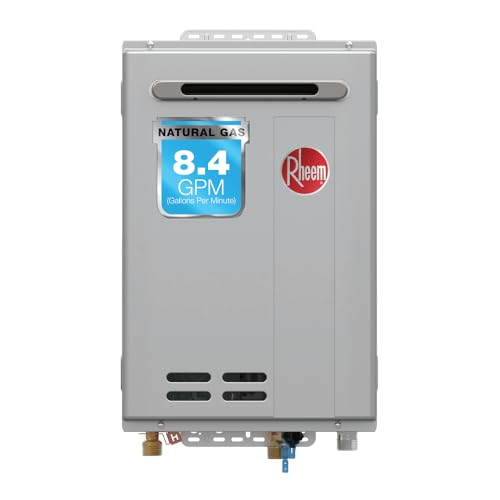
Rheem RTG 8.4 GPM Natural Gas Outdoor
$964.10An outdoor unit needs no flue at all, which removes the single most expensive and most dangerous part of a tankless retrofit in a climate that never freezes hard.
Best for: Warm climate retrofits where running a vent is the problem
Check price on Amazon
Rheem RTG 7.0 GPM Propane Outdoor
$770.17The propane version of the same outdoor chassis. Propane and natural gas units are not interchangeable and are not field convertible on this line.
Best for: Propane properties with no natural gas service
Check price on AmazonFrequently asked questions
- What size tankless water heater do I need for 1 fixture?
- About 2 gallons per minute of flow, and at a 60 F inlet reaching 120 F that means a 60 F rise, which takes roughly 73,000 BTU per hour of gas input. The same flow at a warmer inlet needs considerably less input, which is why the inlet temperature matters as much as the fixture count.
- Why does the advertised flow never match what I get?
- Because the advertised figure is measured at a small temperature rise, often 35 F, which almost nobody actually has. Flow and rise trade against each other directly, so at double the rise a unit makes half the flow. The installation manual publishes a flow curve against rise, and that curve is the honest specification.
- Is a 60 F inlet temperature realistic?
- It is realistic for warmer regions and for much of the year elsewhere. Groundwater temperature swings through the year, so check your own inlet in late winter rather than in the autumn, because that is when the rise is largest and the unit is most stretched.
- Can an electric tankless unit handle this?
- It would take about 17.9 kilowatts, which is roughly 75 amps at 240 volts before the continuous load factor is applied. That is within reach on a larger service, but it still means multiple dedicated circuits and a load calculation before anything is ordered.
- Should I fit low flow shower heads instead of a bigger unit?
- Often yes, and it is the cheapest change available. Moving from 2.5 to 1.75 gallons per minute per head cuts the simultaneous flow by close to 30 percent, which can drop a whole unit size and take the gas line upsizing off the quote entirely. Two or three efficient heads cost a fraction of the difference between unit sizes.
Gas and flue work belongs to a licensed plumber or gas fitter. An undersized gas line starves a burner, and a starved burner produces carbon monoxide. Backdrafting on an atmospheric vent is real, it is invisible, and it kills. Nothing on this page is a substitute for the sizing done by the person who signs the permit, and a working carbon monoxide alarm belongs on every floor of a house with a gas appliance.