Whole house gas tankless
Rinnai RX160iN Condensing Specifications
Researched from the DOE test procedures, NFPA 54 and NEC code tables, and manufacturer specifications. Updated .
Quick answer
This page collects what is actually published about the Rinnai RX160iN Condensing and shows what those figures produce, computed rather than transcribed. Anything the listing does not publish is not filled in with an estimate.
Published specifications
Everything here is taken from the listing or the manufacturer, and nothing is inferred.
| Specification | Value |
|---|---|
| Fuel | Natural gas |
| Condensing | Yes |
| Mounting | Indoor |
Published standard Source: Manufacturer listing data. A specification not listed here is one this listing does not publish. Check the installation manual for the full data plate.
Why there is no performance table on this page
This listing does not publish an input rating in BTU per hour or in kilowatts, and without one there is nothing to compute a flow rate or a recovery rate from. Estimating it from the price or from the physical size would produce a confident number with nothing behind it, so this page does not.
The installation manual for this model publishes the input rating on its data plate. Once you have that figure, the recovery rate calculator and the tankless sizing calculator will do the rest.
How it sits against the rest of its category
There is a full review of the Rinnai RX160iN Condensing covering who it suits and who should not buy it.
Other whole house gas tankless in this catalog: Takagi T-H3S-OS-N Condensing Outdoor, A.O. Smith ATI-540P-N 199K BTU, Rheem RTG 7.0 GPM Natural Gas Indoor, Rheem RTG 8.4 GPM Natural Gas Outdoor.
Compare them on input rating and on the figures the manufacturer actually publishes rather than on the headline number in the listing title, which in this category is frequently a maximum measured under conditions the listing never states.
Other whole house gas tankless
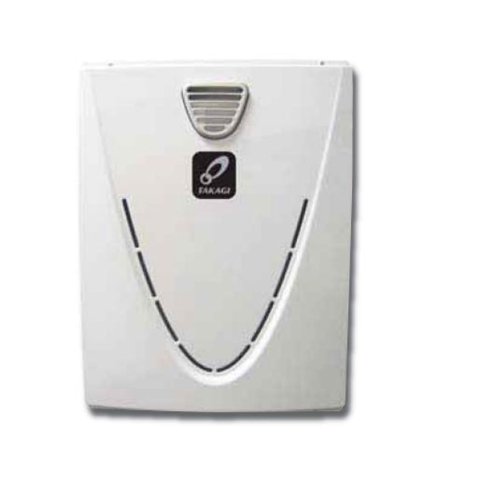
Takagi T-H3S-OS-N Condensing Outdoor
$1,355.95A condensing outdoor unit, which is an unusual combination: it takes the vent problem off the table while keeping condensing efficiency.
Best for: Warm climates that still want a high efficiency unit
Check price on Amazon
A.O. Smith ATI-540P-N 199K BTU
$1,449.99At 199,000 BTU this is the largest residential input sold without crossing into commercial gas piping territory, and the gas line is usually what stops a unit this size.
Best for: Large houses, and only after the gas line has been sized
Check price on Amazon
Rheem RTG 7.0 GPM Natural Gas Indoor
$653.77A 160,000 BTU non-condensing indoor unit, which is the cheapest way into a real brand-name gas tankless with a dealer parts channel behind it.
Best for: A one or two bathroom house in a warm inlet climate
Check price on AmazonFrequently asked questions
- What are the specifications of the Rinnai RX160iN Condensing?
- The listing publishes fuel, condensing, mounting and related figures, shown in full in the table on this page. Anything not shown is something the listing does not publish, and this page does not estimate it.
- Is this page based on hands-on testing?
- No, and we never claim otherwise. Everything here is compiled from the manufacturer listing, published specifications and the energy relations that turn those specifications into flow and recovery figures. We do not test products in person. Where a figure is not published, this page says so rather than estimating it.
- Are the prices on this page current?
- They come from verified catalog data at the time the page was built, and prices in this category move often. Treat any price shown as a guide and check the listing itself before deciding. Availability moves even faster than price does on water heater accessories in particular.
A water heater is a pressure vessel. The temperature and pressure relief valve is the one component on it that is never capped, plugged or removed, and a valve that will not open when you lift the test lever has failed and needs replacing rather than ignoring. If the valve weeps after the heater runs, that is thermal expansion in a closed system and the answer is an expansion tank or a pressure reducing valve, never a cap.