First hour rating
First Hour Rating of a 30 Gallon Electric Water Heater
Researched from the DOE test procedures, NFPA 54 and NEC code tables, and manufacturer specifications. Updated .
Quick answer
First hour rating is the gallons of hot water a heater delivers in one hour starting from full. It is the usable part of the storage plus one hour of recovery, and it is the number that decides whether a household runs out.
For a 30 gallon electric tank that works out near 42 gallons. Electric tanks carry a lower first hour rating relative to their size because a single 4,500 watt element is about 15,400 BTU per hour of heat, less than half a typical gas burner.
Where the 42 gallon figure comes from
| Component | Figure | Basis |
|---|---|---|
| Tank capacity | 30 gal | Nameplate |
| Usable fraction | 70% | Planning convention |
| Usable storage | 21 gal | Computed |
| Recovery at a 90 F rise | 20.5 gal per hour | Computed from the input rating |
| Estimated first hour rating | 42 gal | Storage plus recovery |
Convention Source: Usable fraction is a planning convention. The recovery figure is computed from the published energy relation. The published DOE first hour rating is a MEASURED test result. This is an estimate of it, for the case where the label is missing or unreadable.
How the temperature rise changes it
Recovery rate falls as the temperature rise climbs, because the same energy has to lift each gallon further. A tank in a cold inlet region has a genuinely lower first hour rating than the same tank in a warm one.
| Temperature rise | Recovery | Estimated first hour rating |
|---|---|---|
| 60 F | 30.7 GPH | 52 gal |
| 70 F | 26.3 GPH | 47 gal |
| 80 F | 23 GPH | 44 gal |
| 90 F | 20.5 GPH | 42 gal |
| 100 F | 18.4 GPH | 39 gal |
Published standard Source: Energy relation Q = m x c x dT, with the usable fraction convention applied to the storage term. The DOE test procedure uses a defined rise, so a label figure is not directly comparable to a row here at a different rise.
Is 42 gallons enough?
Compare it against your peak hour demand rather than against your daily use. A four person, two bathroom household uses about 54 gallons in its busiest hour, so a first hour rating of 42 falls short of it and that household would run out during the morning.
Work out your own with the peak hour demand calculator, then check the tank against the tank size pages for your household.
What raises a first hour rating without a bigger tank
Three things, in order of how much they help. A higher wattage element raises recovery directly, within what the circuit and the thermostat allow. A thermostatic mixing valve lets the tank store hotter and deliver at a safe temperature, which increases the usable gallons out of the same storage. And reducing the peak itself, by moving an appliance out of the busy hour or fitting a lower flow shower head, works on the other side of the equation.
Electric tanks and the parts that raise usable output

Rheem PROE50 M2 50 Gallon
$945.99The professional line 50 gallon electric, which is the single most common residential water heater size in the country.
Best for: A straight 50 gallon electric replacement
Check price on Amazon
GE 40 Gallon Lowboy
$522.00A lowboy is short and wide, which is the answer when the tank has to fit under a stair or in a crawlspace and the tall version physically will not go in.
Best for: Height restricted closets and crawlspaces
Check price on Amazon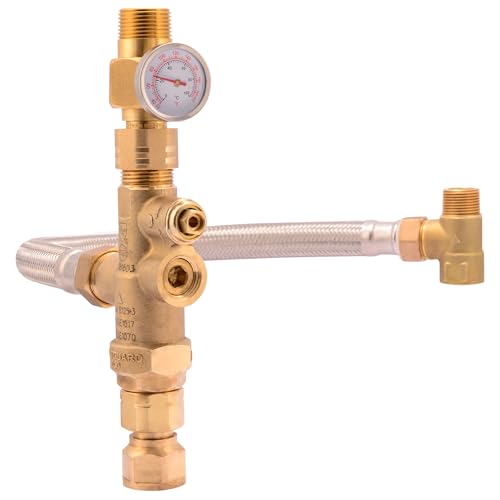
Cash Acme 3/4 in Tank Booster with TMV
$145.00A tank booster mixes cold back into the outlet, so a tank stored at 140 F delivers at 120 F and yields more usable hot water from the same gallons.
Best for: Getting more usable hot water without a bigger tank
Check price on AmazonFrequently asked questions
- What is the first hour rating of a 30 gallon electric water heater?
- About 42 gallons with a 4,500 watt element at a 90 F rise: 21 gallons of usable storage plus 20.5 gallons of recovery during the hour. The exact figure depends on the input rating of the specific model and on your temperature rise, and the measured DOE figure is printed on the yellow EnergyGuide label.
- Why is first hour rating higher than the tank capacity?
- Because the heater keeps working while you draw. The burner or element runs the whole hour, reheating incoming cold water as it arrives, so the total delivered exceeds what the tank holds. This is why a gas tank with a fast burner can show a first hour rating well above its nameplate gallons.
- Is the first hour rating on the label the same as this estimate?
- No, and where the label figure exists it governs. The DOE first hour rating is measured under a defined test procedure with a defined rise and draw pattern. This page estimates it from the tank size and the input rating for the case where the label is missing, painted over or unreadable, which is common on an older heater.
- Would a larger tank help more than a faster element?
- It depends on the shape of your demand. A larger tank helps a household with one big concentrated draw, because storage covers it. A faster recovery rate helps a household with repeated draws through the morning, because the heater catches up between them. Counting the peak hour tells you which shape you have.
- Does storing water hotter increase the first hour rating?
- It increases the usable gallons, which is part of the same thing. Storing at 140 F and mixing down to 120 F at a thermostatic mixing valve yields more usable hot water from the same tank than storing at 120 F does. That comes with a scald consideration, which is why the mixing valve is the required part of the arrangement rather than an optional one.
Turn the breaker off before touching an element. Both legs of a 240 volt circuit are live, so switching one of them off is not enough, and testing with a meter before you touch anything is the habit that matters. Never energise an element that is not submerged: dry firing destroys an element in seconds and can crack the tank lining around it.