Accessories
Best Thermostatic Mixing Valves for Water Heaters
Researched from the DOE test procedures, NFPA 54 and NEC code tables, and manufacturer specifications. Updated .
Quick answer
Two safety goals pull in opposite directions at a water heater. Legionella bacteria, which can cause a serious respiratory illness, survive and multiply in water stored in the range roughly between 68 F and 122 F, which argues for storing hot water well above that range, commonly at 140 F or higher. But water at 140 F causes a serious scald injury to skin in a matter of seconds, and 120 F is the more commonly cited safe setpoint for water actually touching a person at a tap or shower.
A thermostatic mixing valve resolves that tension rather than forcing a choice between the two: it installs on the tank's hot outlet, takes water stored hot from the tank, and blends it with cold water to a fixed, adjustable delivery temperature before that water reaches any fixture in the house. The tank stores hot enough to suppress Legionella growth; every tap and shower in the house sees only the safe blended temperature. A genuine bonus of storing hotter is more usable hot water out of the same tank, since a smaller volume of very hot water blends down to a larger volume of safely warm water than the tank's stated capacity alone would suggest.
Why does a mixing valve need an ASSE listing, specifically?
ASSE 1017 is the standard that governs temperature actuated mixing valves used for hot water distribution systems, and ASSE 1070 covers point-of-use devices for the same scald protection purpose. A mixing valve's entire function on this application is to prevent a scald injury by guaranteeing delivered water never exceeds a safe temperature even if incoming hot water temperature spikes or cold supply pressure drops. That is a safety-critical, fail-safe function, not a comfort feature.
On a device whose entire job is scald prevention, the listing is not a feature to compare against price or finish, it is the product itself. A valve that does not state an ASSE listing on its specification sheet has not been independently tested and certified to actually fail safely under the conditions that listing covers, such as a cold water supply interruption. Buying an unlisted valve for this application means trusting an unverified claim about the one thing the device exists to guarantee. If a listing does not clearly state ASSE 1017 or ASSE 1070 as applicable, do not substitute it for one that does, regardless of price or apparent similarity.
An ASSE listing is not a nice-to-have on a scald control device, it is the requirement. Never install a mixing valve for scald protection that does not explicitly state an ASSE 1017 or ASSE 1070 listing.
How does a mixing valve resolve the scald-versus-Legionella tradeoff?
Storing water at 140 F or higher denies Legionella bacteria the temperature range they need to survive and multiply, which is the standard mitigation recommended where Legionella risk is a specific concern, such as a home with an immunocompromised occupant or a property that sits unused for extended stretches. But 140 F water reaching a shower or a child's hands is a serious scald hazard within seconds of contact.
A thermostatic mixing valve installed at the tank outlet removes the need to choose one setpoint for both jobs. The tank's internal thermostat is set high, for Legionella control. The mixing valve, downstream of the tank, blends that hot water with cold to a separate, lower delivery temperature, commonly in the 120 F range, before it reaches any fixture in the house. Every fixture only ever sees the blended, safe temperature, regardless of what the tank itself is storing.
How does a mixing valve get more usable hot water out of the same tank?
This is a genuine practical bonus beyond the safety case. A tank storing water at 140 F holds more usable heat energy per gallon than the same tank storing at 120 F. When that hotter water passes through a mixing valve and blends with cold water down to a 120 F delivery temperature, the total blended volume delivered is larger than the tank's stated capacity, because a portion of the blend is cold water doing part of the work. In practical terms, a 40 gallon tank set to 140 F and mixed down to 120 F at the valve behaves, from the perspective of usable hot water at the tap, closer to a meaningfully larger tank at 120 F alone. This does not change the tank's actual capacity or recovery rate, only how much of the blended delivery is usable before running out.
ASSE 1017 versus ASSE 1070: which listing applies to my installation?
| Standard | Installation point | Typical use case |
|---|---|---|
| ASSE 1017 | At the water heater outlet, whole-house | Blends the entire house supply down from a hot tank setpoint |
| ASSE 1070 | At an individual fixture or point of use | Blends only one shower, tub, or sink locally |
Published standard Source: ASSE International product standards ASSE 1017 (Temperature Actuated Mixing Valves for Hot Water Distribution Systems) and ASSE 1070 (Water Temperature Limiting Devices).. Confirm which standard a specific product listing states before buying; the two standards apply to different installation points and are not interchangeable.
How we chose
We did not install or pressure test these valves in person. These picks are compiled from manufacturer published specifications, most importantly a clearly stated ASSE 1017 or ASSE 1070 listing, plus flow rate, connection type, and adjustable temperature range, and the consensus of verified owner reviews for setpoint stability and fitting fit. Any product without a clearly documented ASSE listing was excluded outright regardless of other specifications.
Buying tips
Confirm your tank's outlet fitting size and thread type before ordering, and check whether a push-fit, crimp, or threaded connection matches your existing plumbing to avoid needing an additional adapter. If a household includes an immunocompromised occupant, an infant, or an elderly resident sensitive to both scald risk and Legionella exposure, this is one of the few accessories on this site worth treating as close to mandatory rather than optional, alongside consulting the reasoning in the Legionella and water heater temperature guide.
The Expert-tier higher-capacity Watts valve is built for a larger household or higher simultaneous fixture demand than a standard single valve handles well. For a typical single-family home with one water heater, a standard-capacity ASSE 1017 valve at the tank outlet is the correct scope and nothing more is needed.
The picks, by tier
Every valve in this list is chosen specifically because its listing is documented. If a valve you are considering elsewhere does not state its ASSE listing, treat that as disqualifying rather than incidental for a scald control application.

AZK Tank Booster Kit, ASSE Listed
$107.69A budget tank-outlet mixing valve with a stated listing, suited to a straightforward single-tank residential installation.
Best for: A budget tank booster that still names its listings
Check price on Amazon
Charman 3/4 in Tank Booster with Gauge
$111.99A comparable budget tank-outlet valve to the AZK, worth comparing on fitting size for your specific tank.
Best for: Anyone who wants to see the delivered temperature
Check price on Amazon
Cash Acme HG110-D SharkBite Connect
$110.53A push-fit SharkBite connection version of the Cashacme valve, avoiding a soldering step for a straightforward DIY-adjacent installation.
Best for: A copper or PEX retrofit with no torch
Check price on Amazon
Cash Acme HG110 1/2 in Crimp
$83.99A crimp-fitting version of the same Cashacme valve for a PEX installation using crimp rings rather than push-fit or threaded connections.
Best for: A PEX branch or a single fixture
Check price on Amazon
Cash Acme HG110-D 3/4 in FNPT
$109.00The buy-once pick with standard FNPT threaded connections, an ASSE 1017 listing, and a track record specifically as a tank-outlet scald control valve.
Best for: A threaded outlet retrofit
Check price on Amazon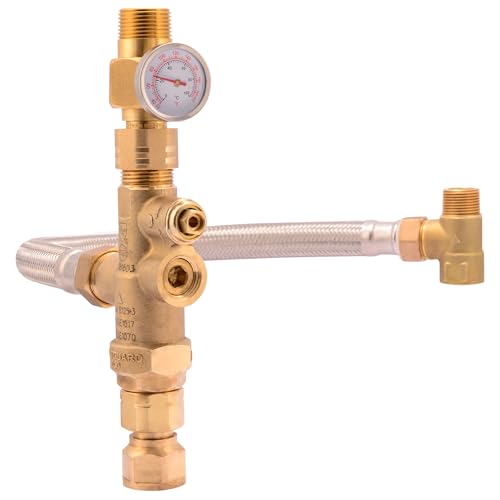
Cash Acme 3/4 in Tank Booster with TMV
$145.00A comparable Cashacme model for a tank booster application, worth comparing on fitting configuration against the HG110D.
Best for: Getting more usable hot water without a bigger tank
Check price on Amazon
Watts Under Sink Guardian USG-B-M2
$97.18A higher-capacity Watts mixing valve suited to a larger household, a higher flow demand, or a setup feeding more simultaneous fixtures than a standard single valve is rated for.
Best for: One basin used by a child or an older adult
Check price on AmazonFrequently asked questions
- Why does a thermostatic mixing valve need an ASSE listing?
- A mixing valve used for scald protection is a safety-critical device, and ASSE 1017 or ASSE 1070 listing means it has been independently tested to reliably deliver a safe blended temperature, including under fault conditions like a cold supply interruption. On this application, the listing is the product's core function being verified, not an optional feature to weigh against price.
- What temperature should I set my water heater to if I use a mixing valve?
- A common approach is storing tank water at 140 F or higher to suppress Legionella bacteria growth, then using an ASSE 1017 listed mixing valve at the tank outlet to blend delivered water down to a safe temperature, commonly around 120 F, at every fixture in the house. This lets both safety goals be met without compromising on either one.
- Does a mixing valve really give me more hot water from the same tank?
- Yes, in a practical sense. A tank storing hotter water, then blended down at the mixing valve with cold water to a lower delivery temperature, produces more total blended volume at that delivery temperature than the tank's stated capacity alone, since part of the blend is cold water. The tank's actual capacity and recovery rate are unchanged; only usable delivered volume increases.
- What is the difference between ASSE 1017 and ASSE 1070?
- ASSE 1017 covers mixing valves installed at the water heater outlet that blend the entire house's hot water supply down from a hot tank setpoint. ASSE 1070 covers valves installed at an individual fixture, such as one shower, blending only that one point of use. They apply to different installation locations and are not interchangeable.
- Can I use an unlisted mixing valve if it seems similar to a listed one?
- No. Do not substitute an unlisted valve for one with a documented ASSE 1017 or ASSE 1070 listing regardless of apparent similarity or price. The listing verifies the valve reliably prevents scalding under real fault conditions, which is the entire purpose of the device, and an unlisted valve has not been independently confirmed to do that.
- Is a mixing valve required by code?
- Requirements vary by jurisdiction and by whether a tank is set above a certain temperature threshold, but many plumbing codes require a listed mixing valve wherever a water heater is set to store above 120 F specifically to prevent scalding at fixtures. Check local code, and treat the ASSE listing as non-negotiable regardless of what is strictly required.
On a scald control device, the ASSE listing is the product. Store hot for Legionella control, blend down with a listed valve for safety, and never treat an unlisted valve as an equivalent substitute.