NEC 422.13 makes a storage water heater of 120 gallons or less a continuous load, so the circuit is sized at 125 percent of nameplate. A 4,500 watt element at 240 volts draws 18.8 amps, which becomes 23.4 amps of design load, a 25 or 30 amp breaker and 10 AWG copper.
Result
Breaker per circuit 25 APublished standard
Copper conductor 10 AWG Published standard
Total draw 18.8 APublished standard
Design load per circuit 23.4 APublished standard
Total breaker capacity 25 APublished standard
Turn the breaker off before touching an element, and never energise an element that is not submerged. Dry-firing destroys an element in seconds.
The formula
Amps = watts / volts. Design amps = amps x 1.25 (continuous load). Breaker = next standard size at or above design amps. Conductor = smallest AWG whose 75 C ampacity meets the design load and whose NEC 240.4(D) limit permits that breaker.
The number of CIRCUITS matters and is not a detail. Electric tankless units above roughly 14 kW are internally split across two or three circuits, and the count is published in the installation manual. Sizing one circuit for the whole load gives a wrong and far more expensive answer.
The figures above are computed with these exact inputs: Total power 4.5 kW, Supply voltage 240, Circuits the unit splits across 1.
What this calculator assumes
Some of these are published test procedures or code tables and some are planning conventions. They
are not the same kind of number, so each one is labeled.
Assumption
Kind
Where it comes from
Nec42213: 1.25
Published standard
NEC 422.13, a storage water heater of 120 gallons or less is a continuous load, so the circuit is sized at 125 percent of the nameplate
NEC Table 310
Published standard
NEC Table 310.16 ampacity, copper, 75 C column
NEC 240
Published standard
NEC 240.4(D), overcurrent limits for 14, 12 and 10 AWG conductors regardless of their table ampacity
Gear that matches this result
Every card below is in the page source. The calculator re-ranks them against your numbers and marks anything that falls short of what you just calculated.
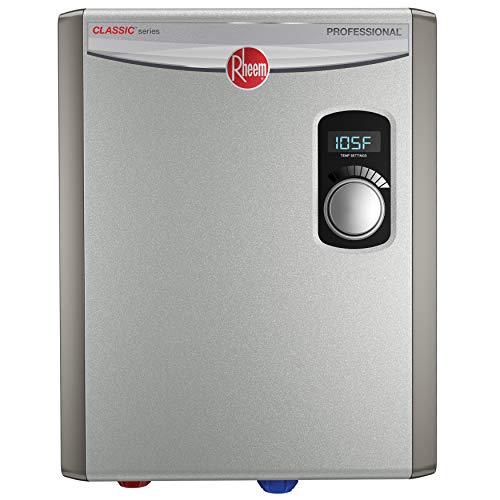
Thirteen kilowatts at 240 volts is about 54 amps, which many existing panels can take. In a warm inlet climate it supports roughly one shower at a time.
Best for: A single bathroom in a warm inlet climate
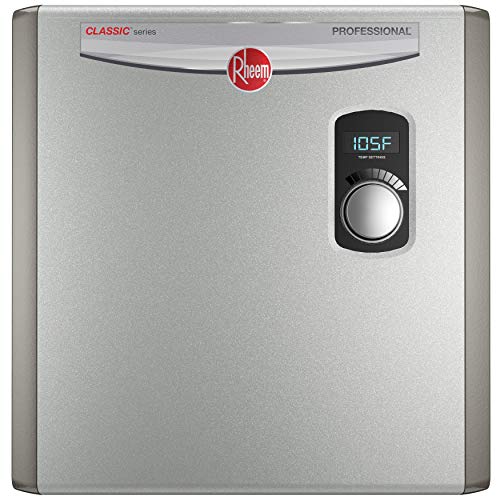
Eighteen kilowatts draws 75 amps across two circuits. This is the largest electric tankless a typical 200 amp service absorbs without a load calculation fight.
Best for: The realistic ceiling on a 200 amp service
Twenty four kilowatts is 100 amps of continuous load. Read that number before reading the price, because the service upgrade costs more than the heater.
Best for: Houses with service capacity already proven
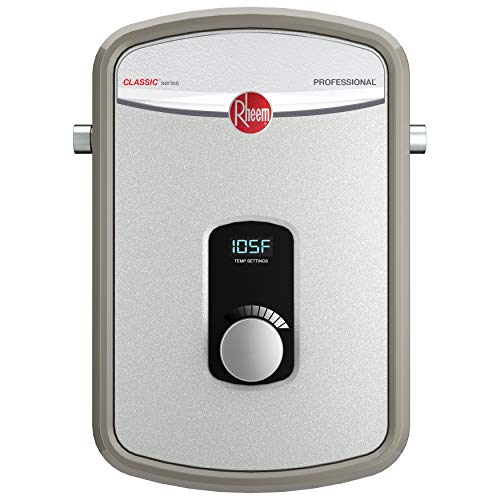
Eleven kilowatts on a 60 amp circuit. It will run a shower in Florida and will not run one in Minnesota, and that is the whole electric tankless story.
A 4,500 watt element at 240 volts draws 18.75 amps. NEC 422.13 treats a storage water heater of 120 gallons or less as a continuous load, so the circuit is sized at 125 percent, which is 23.4 amps. That calls for a 25 or 30 amp double pole breaker and 10 AWG copper conductors. A 30 amp breaker with 10 AWG is the usual installation.
Why is the breaker bigger than the current draw?
Because NEC 422.13 classes a storage water heater as a continuous load, meaning it can run for three hours or more at a time. Continuous loads are sized at 125 percent of the nameplate so the breaker is not operating at its limit for hours on end. The extra capacity is a thermal margin for the breaker, not extra current for the heater.
Why does an 18 kW tankless need more than one circuit?
Because 18 kilowatts at 240 volts is 75 amps, and at the continuous load factor that is a 100 amp branch circuit, which is impractical to run and to terminate. Manufacturers split the load internally across two or three separate circuits with their own breakers. The installation manual states how many, and sizing one circuit for the whole load gives a wrong answer.
Can I reuse the existing water heater circuit for a tankless unit?
Almost never. A tank element circuit is typically 30 amps on 10 AWG, while even a modest whole house electric tankless needs 60 to 100 amps across multiple circuits. That is a panel and often a service question rather than a wiring question. Have an electrician do a load calculation before buying the unit, not after.
Researched guidance, not professional advice. These results are planning figures from
published test procedures, code tables and manufacturer specifications, and they do not replace a
sizing done by the person who will sign the permit. A water heater is a pressure vessel: never cap,
plug or remove the temperature and pressure relief valve, and replace one that will not open when the
test lever is lifted. Gas line, flue and vent work belongs to a licensed plumber or gas fitter,
because improper venting produces carbon monoxide. Water at 140 F scalds a child in seconds. Turn off
the breaker before touching an element, and never energise an element that is not submerged.